Letter number 168 of November 2025
- TOPIC
- STATISTICS
- RESEARCH
- QUESTIONS & COMMENTS
- NEW
News : How does a CFO assess public debt?
By François Meunier
Former executive of an insurance company, affiliate professor at ENSAE-IPP.
Are the issues faced by CFOs similar to those faced by their quasi-counterparts, the finance ministers? Many say no, arguing that the state is not an entity like a company. In particular, a state, in principle, never dies, which changes the way lenders view it.
But the parallel is worth examining. To do so, let's make the CFO a kind of Candide looking at state financing.
Traditionally, CFOs have three concerns: the company's profitability, solvency, and liquidity. A company is considered solvent if the financial value of its assets allows it to repay its debt at market value under all circumstances. This concept depends in part on profitability. Indeed, the value of assets is nothing more than the present value of what they will yield in future cash flows. It is therefore sufficient for the return on assets to remain higher than the cost of debt for the company to have assured solvency and even a margin for borrowing.
Our Candide can therefore wisely state a first rule common to corporate finance and public finance: if the return on public spending remains higher than the cost of debt, the state will never have a debt problem. In other words, excessive debt problems are always and everywhere, for both companies and governments, problems of inappropriate spending, or, to use financial terminology, “unprofitable” spending.
The “return” on public spending is non-marketable
Of course, things get complicated. The return on public spending is not monetary, at least not immediately; it is largely social. It may be possible to measure the profitability of a bridge or a railway line, and many people say that the government should only finance infrastructure spending through debt. But this is more difficult, if not impossible, for youth education, public safety, or effective justice, all of which also contribute to this return, regardless of how they are financed.
In this respect, the CFO is in a more convenient position than his counterpart, the finance minister. The company operates in a market environment, with prices, costs, and results that can be measured in monetary terms. Public spending decisions are rarely based on financial calculations; they are political decisions. This is why we need institutions and evaluation principles that enable politicians to judge the appropriateness of spending, both before and after it is incurred.
However, it would be illusory to think that financial calculations are the only criterion for investment within a company. Any risky project requires politics, in the best sense of the word, namely reasoned arbitration between interests that do not always converge.
In any case, our Candide can make an initial diagnosis of France's budgetary situation: our country has accumulated so much debt because the choices made over time in terms of public spending have not been the right ones on average. They have not resulted in an increase in national income, i.e., growth, which would have made it possible to contain the level of debt relative to GDP. If we try to solve every problem the country faces by resorting to public spending, it is likely that, without thinking about the return on the amount committed, the new spending will not be good spending, in the sense of being able to return the funds invested to the community. In France, it is not that we are borrowing too much, it is that we are spending badly.
We have discussed solvency, whereas in public finance we often hear the term sustainability. The concepts are very similar. For the government, solvency means that its tax collection potential will always enable it to repay its debt. This is the case if public spending “yields” more than the cost of the debt, because then the government will always be able to “roll over” its debt, i.e., repay the current debt by issuing new debt. In technical jargon, debt is sustainable if the cost of debt r remains lower than economic growth g and therefore, approximately, lower than tax revenue growth: r < g. With one adjustment, this rule applies equally to businesses.
The state has no shareholders.
The CFO is subject to stricter discipline than his colleague in public finance. For him or her, profitability does not mean having a return on assets that exceeds the cost of debt alone, but rather exceeds the total cost of capital, debt and equity. This is because shareholders must also be remunerated and, given the risks involved, they are paid more for their contribution of funds. Otherwise, they will be reluctant to finance the investment and will prefer to have their money returned in the form of dividends or share buybacks[1].
The concept of solvency therefore becomes more restrictive: a company is solvent if, in the event of a setback or economic downturn, it remains able to raise funds from shareholders who are convinced that the company is healthy and therefore their investment is profitable.
The state, for its part, has no shareholders in the strict sense of the term, except perhaps, stretching the meaning of the words, the citizens who control it. With no shareholders or equity to remunerate, the only benchmark for profitability is the interest rate on debt. This is why the discount rate it uses to calculate the opportunity cost of certain public projects is currently 3.2%[2] in France, well below the cost of capital on the financial markets.
But the difference is smaller than it seems. The CEO of a company would rather send his CFO to negotiate additional financing with a bank than have to argue for a capital increase before a shareholders' meeting. Similarly, a government never likes to resort to taxation to balance its budget, as this is unpopular. If there is one difference, it is that a shareholder can refuse to contribute funds, while taxpayers cannot, except through tax revolt, of which history provides many examples, or more wisely through the voting rights they have, just like shareholders.
Hence the dilemma of public finances: it is very easy to raise public debt as long as solvency is not threatened, and we have seen that it is difficult to measure. This ease of debt becomes a weakness: without real financing constraints, we allow ourselves to spend unwisely. Financing through taxation for the state or through capital raising for the company imposes greater discipline in the use of funds.
And, of course, there are limits to the use of debt. If the financial markets realize that there is no more room for manoeuvre in terms of raising taxes, they will start to demand higher returns on loans. Then, they will stop lending altogether. The government will then find itself in a cash flow crisis. How will it pay its expenses?
Less liquidity pressure
This brings us to the CFO's third concern: ensuring sufficient liquidity, i.e., the ability to meet payment commitments as they arise.
If the company is solvent, liquidity pressure is not really a problem because it will always find the liquidity line that will get it through the crisis. But if solvency is threatened, the government and the company are no longer on equal footing. We have already seen that the government, through taxation, can take risks and force its “shareholders” to contribute to the pot. Above all, however, the state benefits from a lender of last resort that the company lacks. All it needs to do is control, as sovereign, the issuance of another class of debt, preferably debt that does not bear interest and that cannot be refused. This debt has a name: currency, which it obtains by turning to its central bank.
The central bank is independent by institutional convention and is reluctant to finance the Treasury monetarily. As the guardian of inflation, it understands the link between excess money in circulation and inflation, even if this link is far from mechanical. But history shows that in the event of a government financing crisis, it rarely fails to come to its rescue.
Inflation is nothing more than a default, financially speaking: 10% inflation over three years erodes the purchasing power of government bonds by 30%. It is as if creditors had to take a 30% haircut during a restructuring. Of course, inflation allows this discount to be surreptitious, whereas a default on public debt is a major financial and political event. It should be noted that the CFO also benefits from this dilution of public debt through inflation, as she sees her own debts depreciate in relation to her turnover or profits if these evolve at roughly the same rate as inflation.
This possibility of having a backup option through the monetization of public spending only applies if the debt is issued in the country's currency. Being indebted in another currency puts the government in the same position as a company for which debt is a hard constraint. Less developed countries know this: lacking abundant local savings and international recognition of their currency, they must borrow externally and in a third currency.
Eurozone countries are also taking on debt, but in euros, a currency over which they have partially relinquished their sovereignty. Under the treaty, the ECB is not authorized to act as lender of last resort to a member state of the monetary union, as Greece learned to its cost. This prohibition was partially lifted when the systemic nature of the euro crisis became apparent in 2011 (Mario Draghi's “whatever it takes”), but it remains in place. This is what should alert French government officials, unless they want to play the “too big to fail” card.
Financing through taxes or debt?
As we have seen, the most important thing for a company is the quality of its assets, which consist of its past expenditure on labour and investment. The method of financing these assets, whether through debt or equity, is of secondary importance. There is even a fundamental result in corporate finance, known as the Modigliani-Miller theorem[3], which states that, under certain conditions, it makes no difference to the company and its stakeholders whether these assets are financed by one or the other.
Would the same apply to the state? Would financing through taxation or debt be the same thing? A small minority of economists believe so (the Ricardo-Barro result, the Modigliani-Miller theorem of public finance). According to them, private agents who subscribe to debt and are happy to avoid paying taxes know that the debt raised will one day have to be repaid out of their own pockets. They therefore adjust their spending behaviour as if the funds raised by the government had been raised through taxation, so that they are ready to pay when the time comes. Of course, this does not work. If Candide is allowed to avoid paying taxes, that does not mean he will put aside the money that has not been taken from him. This kind of short-sightedness on the part of the private sector makes fiscal stimulus effective. The income distributed by the government is spent, indirectly generating other income and, miraculously, returning to the government in part in the form of taxes. Businesses do not have the good fortune of seeing the money they spend automatically return to their coffers, although it was once said that Ford paid his workers well because that way he could sell them cars.
So taxes and debt, as methods of financing the government, have significantly different effects. If further proof were needed, it is not the same people who are affected. Interest on government bonds only goes to households that have sufficient savings to buy them, whereas taxes affect both rich and poor, if we bear in mind the universal nature of indirect taxes.
Should we guarantee balanced public accounts?
France has not recorded a single budget surplus since 1973. Is this sustainable? Could a company afford to consistently post losses and therefore never pay dividends to its shareholders?
Candide knows accounting and understands that the government's budget balance is a cash balance, similar to operating cash flow, while a company's net income only takes into account part of its investment and working capital requirements through depreciation. The comparison is only valid if it is made on the same terms.
The right question is: can a company repeatedly find itself in a situation of negative cash flow? The answer is of course yes, as long as the company is investing to fuel strong growth, provided that it complies with solvency requirements. This is how startups raise funds over a very long period of time. In public accounting, they would always be in deficit. Consequently, a government can run a public deficit over time if its spending can promote GDP growth, and therefore tax revenue, that exceeds the cost of its debt. Let's assume that GDP and public spending always grow by 4% in nominal terms and that the government wants to maintain its public debt at, say, 50% of GDP. It will have to continually borrow and run a negative cash flow. But this will only be possible over time if the cost of its debt remains below 4%.
We can clearly see the risk of drift that this attractive conclusion implies. Because 52 years since 1973 is a very long time. Bad spending is never far away if the tap is so easily turned on.
But Candide is shocked when he sees certain states, Germany in particular, passing a constitutional law prohibiting public deficits (except in the event of economic uncertainty). On the one hand, this forces them to accept low growth and hoard trade surpluses, a Malthusian attitude that has weighed on the entire European economy since the introduction of the euro; on the other hand, it shows little respect for representative democracy, as it seeks to tie it to the mast and prevent it from freely exercising its budgetary control function. Fiscal responsibility can only be learned through the free exercise of responsibility. Germany was pitifully forced to unravel this law under the recent Merz government, when public opinion became aware of the abysmal lag in military and infrastructure spending that this zeal had caused.
Finally, there is public spending that serves the purpose of regulating the economy. Candide has heard of Keynes. In times of crisis, fiscal policy is used to put purchasing power in the hands of the private sector. This stimulates economic activity through consumer spending and investment. The concern for profitability becomes secondary, but on reflection, it is not entirely absent, since the aim is to prevent the economy from sinking into underemployment. The state plays an insurance role here, but its intervention must remain occasional, because an insurer that always pays out claims without collecting premiums would quickly lose all credibility. In the long run, the criterion of (social) profitability is the only one that counts. Good public spending, like good corporate spending, is spending that “pays off.”
Is the state indebting itself at the expense of future generations?
One last question, dear Candide: when it comes to public debt, we often hear that the current generation benefits from it, but that it is their children who pay for it. The parents drink, the children pay the price, so to speak. What do you think?
This is a fallacy that must be dismissed. No, public debt does not steal from future generations.
Firstly, if the government borrows, it is because someone is lending to it. Someone from the current generation takes money out of their pocket to finance the government, in the same way that they take money out of their pocket when the government collects taxes. In both cases, the current generation, or part of it, refrains from consuming, from drinking, so to speak.
Those who have lent money will be happy later on to be repaid, either personally if it is their retirement fund, or by their children. Public debt, like any debt, moves savings forward in time, to the benefit (or not, that is the question) of our children. The future generation will of course repay the loan, but in reality they will be repaying the person whose parent lent to the government, i.e., someone from the same generation. End of sophistry.
The only really important question, to return to our starting point, is how the funds are spent. If it is a good expenditure, then not only will our children be repaid, but they will also live better. If not, they will curse us. And we will remind them that there is only one debt that is not a journey of savings through time, and that is climate debt. In that case, they will suffer.
[1] Shareholders sometimes encounter difficulties in getting the company to distribute more dividends if, dissatisfied with profitability, they want to withdraw their money. This may be contrary to the company's overriding social interest. Commercial law therefore imposes restrictions.
[2] See Ni, Jincheng and Joël Maurice, Révision du taux d’actualisation, France Stratégie, 23 November 2021.
[3] See chapters 32 and 33 of the Vernimmen.
Statistics : Top 10 European groups by market cap since 2000
We have used the data we publish in the appendix to Vernimmen, presenting the top 20 market capitalisations in 14 countries or geographical areas, with their key figures, to produce the following table:
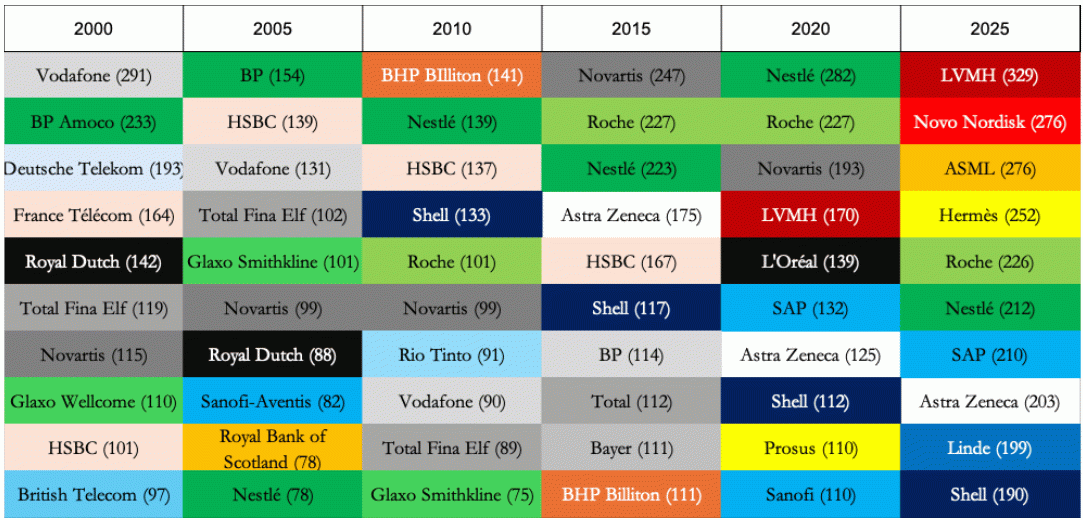
It illustrates how difficult it is to stay at the top. In fact, out of 6 observations every 5 years, there are 29 groups that have been in the top 10 European market capitalisation at least once, remaining there for an average of 10 years. No group have been present consistently. Nestlé and Novartis have been there for 5 periods out of 6
In 25 years, the market capitalisation required to be number one or number ten has only increased by 10%, true from a climax due to the TMT bubble in 2000. In the United States, it has increased sevenfold for the number one (and threefold for the number ten, versus a doubling in Europe). In France and in Switzerland, the top market cap has doubled in value. In Germany, the increase is only 10%; and in the United Kingdom, there has been a decline of one-third.
Industry-wise, the TMT-oil-pharma-bank of 2000 has been replaced 25 years after by a wider array of activities: luxury, pharma, semi-conductors, software, food and chemicals.
Research : The value of banks' reputation in managing share issues
With the collaboration of Simon Gueguen, teacher-researcher at CY Cergy Paris Université
If there is one intangible asset whose value is recognized by finance professionals, it is reputation. When announcing his upcoming retirement from Berkshire Hathaway, Warren Buffett explained that losing money was less serious than losing reputation.
In the case of banks, reputation becomes crucial whenever information asymmetries determine the behavior of actors. This is particularly true in their role as managers of share issues, whether initial public offerings (IPOs) or secondary equity offerings (SEOs)[1] by listed companies. Investors are more likely to buy securities offered by banks that have earned their trust and that offer, for example, high-quality analytical coverage after the issue. The bank's reputation is therefore valuable to the issuing company, and the most reputable banks act as implicit certifiers of the quality of the securities issued.
However, do reputable banks enjoy a competitive advantage that they can pass on to issuers? This is the question that the article we are presenting today[2] seeks to answer.
The paradox stems from the fact that commission rates[3] are concentrated around 7% for IPOs and 4% for SEOs in the United States[4]. Not only is there little variation in the rates charged, but some studies even suggest that commission rates are slightly lower when the bank has a better reputation. At first glance, banks' efforts to build their reputation do not seem to pay off in this area. However, as is often the case in finance, it all depends on how you measure it.
The mistake is to look only at the commission rate, expressed as a percentage, to measure the bank's remuneration. What matters is the remuneration in dollars (or euros)! If reputation reduces information asymmetries and therefore allows securities to be priced higher, the same rate of 7% of the total will yield higher total remuneration. The question is therefore whether a better reputation leads to higher remuneration in dollars, all other things being equal.
There are numerous technical difficulties. First, it must be taken into account that the management of a given issue by a given bank depends both on the issuer's preferences for certain banks and on the banks' preferences for certain issuers. As a result of this market, the largest and/or most reputable companies tend to entrust their issues to the most reputable banks. The authors used a two-stage econometric estimation, the first stage measuring the factors that enable banks and issuers to form partnerships, and the second stage measuring the remuneration of banks by neutralizing the impact of the partnership process and taking into account the characteristics of the issue (size, risk, market conditions). The results are clear: there is a strong positive relationship between reputation[5] and the income received by the bank during issuances.
This relationship is “monotonic” in the mathematical sense of the term, meaning that each improvement in reputation translates into higher revenues. The sample analyzed includes almost all IPOs and SEOs on the US market between 1980 and 2010 (6,378 IPOs and 9,164 SEOs). In this huge sample, a one-standard deviation improvement in reputation corresponds to an additional gain of $300,000 for an IPO (compared to an average total gain of $5.2 million) and $410,000 for an SEO ($5.6 million). The effect is even more dramatic when comparing the revenues of the top 20% in reputation (first quintile) with those of the banks in the bottom 20% in reputation. The difference in favor of the first quintile is $1.15 million for an IPO and $1.23 million for an SEO. Reputation comes at a price, and it is a high one.
In the rest of the article, the authors show that this additional revenue does not come at the expense of issuers. When they choose a reputable bank to lead the transaction, issuers benefit from larger banking syndicates, better coverage by financial analysts, and ultimately better placement of their securities.
The results of the study are consistent with theories of information asymmetry (reputation has value) and the intuitions of practitioners. By applying complex econometric methods to a large sample, the authors show that reputation is highly rewarded in the management of share issues, whereas a naive observation of commission rates might suggest the opposite.
[1] Topics covered in Chapter 25 of Vernimmen.
[2] C.S.FERNANDO, V.A.GATCHEV, A.D.MAY et W.L.MEGGINSON (2025), The value of reputation: evidence from equity underwriting, Journal of Applied Corporate Finance
[3] Corresponding to the difference between the sale price to investors and the price paid to the issuer, on which banks earn their remuneration, divided by the sale price to investors.
[4] Commission rates are significantly lower in Europe due to a greater number of players and stronger competition.
[5] The authors measure reputation either by the bank's market share or by its usual position in investment syndicates (lead manager, major participant, or peripheral participant). Their results are similar in both cases.
Q&A : What is a distressed exchange?
While the US Chapter 11 procedure[1] is relatively well known, not least because it was one of the sources of inspiration for the latest European reform of bankruptcy procedures, distressed exchanges are less familiar. They accounted for less than a quarter of US proceedings in 2020 (compared to around 60% for Chapter 11), but have recently surged to make up two-thirds in 2024:
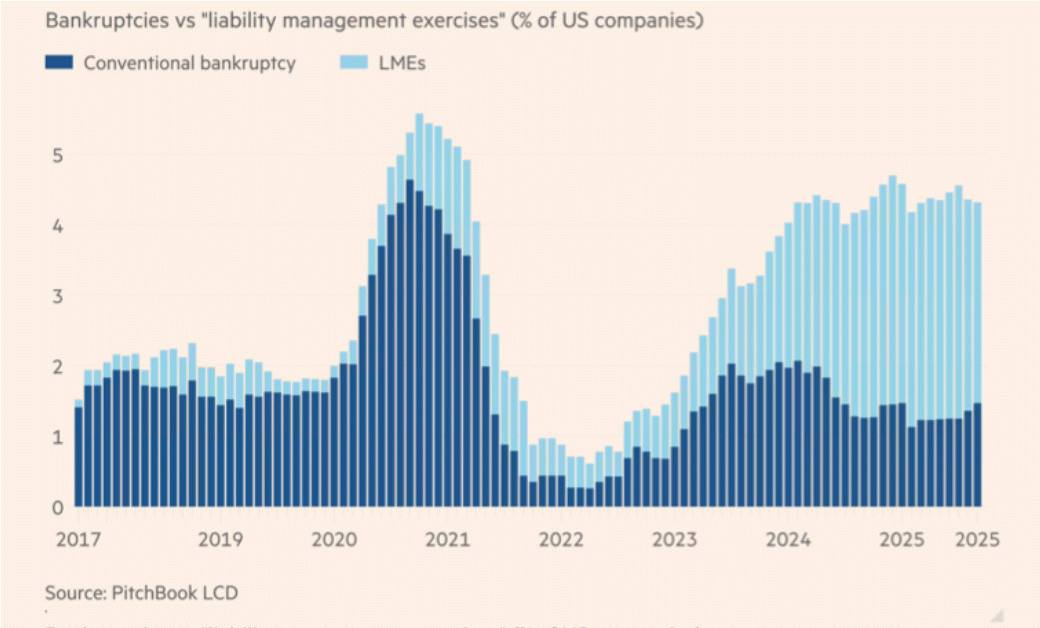
Distressed exchanges are negotiation procedures between the company's various debt and equity investors aimed at restructuring the company's liabilities without going through the courts.
In general, the maturity of the debt is extended, sometimes with partial forgiveness of the principal, or even an increase in the interest rate and/or additional guarantees.
For shareholders, this is a way to buy time in the hope that the value of their shares, which is currently very low or negative, will recover during the period of debt restructuring. However, as this process does not involve a parallel restructuring of assets, with the renegotiation of contracts that have become costly for the company, this recovery still needs to be achieved.
As for lenders, they avoid recognizing a loss and also hope that time will work in their favor, allowing the company to recover[2].
While Echostar and Carvana were able to overcome their difficulties and offer their shareholders and creditors a new lease on life, this is not generally the case, as it is estimated that two-thirds of distressed exchanges end in default.
New : Comments posted on Facebook
Regularly on the Vernimmen.com Facebook page[1] we publish comments on financial news that we deem to be of interest, publish a question and its answer or quote of financial interest. Here are some of our recent comments.
When the Administrative Court of Appeal gives finance lessons to the tax authorities, episode 1 (October 26)
1. To justify a tax adjustment of approximately €300 million for SEITA, the tabacco group subsidiary of Imerial Brands, the tax authorities had calculated the cost of capital using :
- a two-year average of risk-free interest rates
- and a historical risk premium calculated on the basis of the 1987-2012 average.
In the first instance, the court ruled in their favour.
However, on appeal, SEITA won the case.
The Paris Administrative Court of Appeal, which had read its Vernimmen, pointed out that consistency was required in the CAPM formula used to estimate a company's cost of equity, or its cost of capital.
The formula states that the required rate of return is equal to: rf + ß x (E(rm) – rf). A risk premium (E(rm) – rf) is thus added to the risk-free rate (rf), weighted by the beta of the share to determine the cost of equity, or by the beta of operating assets (unleveraged beta) to obtain the cost of capital in the direct approach. It goes without saying that the rf at the beginning of the formula is the same as the rf at the end of the formula in the equity market risk premium!
However, there is every chance that two different values will be used for the same rf in the formula, if we take:
- the risk-free rate of return to be an average interest rate over two years,
- and the risk premium used is calculated as an average of the stock market risk premiums over 25 years.
This is unfortunate, but in this particular case it allowed the tax authorities to apply a lower discount rate than that used by SEITA, resulting in a higher entreprise value than that used by SEITA, hence the adjustment notified.
2. This is precisely why, for years, almost all valuers have been using forward-looking risk premiums rather than historical risk premiums calculated over varying periods of time. The forward-looking risk premium corresponds to the premium observed on the basis of current prices and the future cash flow prospects of the assets.
3. Although the risk premium is very often mentioned, the expected market return (E(rm) in the formula) is in fact a more operational criterion for valuation. It allows the risk premium to be calculated using:
- either a short-term risk-free rate, as we recommend,
- or a long-term rate (10-year OAT), as has been the customary but erroneous practice. Indeed, fluctuations in the price of a long-term OAT clearly show that it is not risk-free, which is unfortunate for a risk-free rate! And yet this is what is required to arrive at the CAPM formula (the standard deviation of risk-free asset returns must be zero).
This frees us from the choice made in this area by the person who calculated and published the risk premium, and avoids the error that the court criticised the tax authorities for.
When the Administrative Court of Appeal gives finance lessons to the tax authorities, episode 2 (October 27)
In the previous post, we saw how the Paris Administrative Court of Appeal corrected the tax authorities, who claimed that, in order to calculate a company's cost of capital, they used a risk-free rate calculated over two years and a historical risk premium calculated over 25 years.
1. To justify its use of a historical premium, the tax authorities argued that it was relevant because Imperial Brands Seita was a long-term shareholder; whereas if it had been a short-term shareholder, a prospective premium would have been relevant.
The rapporteur was not swayed by this specious and sui generis argument put forward by the tax authorities, which contradicted the tax authorities' valuation guide: "In any event, there is no such thing as a sui generis tax value or administrative valuation methods: market value can only be determined by observing the market and using the methods employed by its participants."
The rapporteur emphasised: "If I buy LVMH shares to contribute to a PEA (personal equity plan) to finance my retirement in 20 years' time, or if I buy them to speculate on the stock market in the hope of paying for a trip to Namibia in the short term, the price of the shares will be exactly the same." This is common sense.
And to further disqualify the historical risk premium, the rapporteur repeats one of Vernimmen's arguments. When markets fall because investors demand higher rates of return, the historical risk premium, which is the average of annual market returns in excess of the risk-free rate, falls as a result, even though the rates of return demanded by investors are rising, which is paradoxical.
2. On another point, the tax authorities had considered that all cash assets should be taken into account in the transition from entreprise value to equity value. SEITA contested this, since part of these cash assets is the result of excise duties (SEITA manufactures cigarettes) which it must pay to... the tax authorities.
The rapporteur ruled in SEITA's favour, as the cash counterpart of negative working capital is not automatically a permanent asset of the company and therefore part of its value (see October's Vernimmen newsletter). One can imagine how the tax authorities would have reacted if SEITA had told them that it was unable to pay them the excise duties collected, having used them, for example, to pay a dividend to its shareholder!
3. As SEITA had probably paid the amount of the adjustment, the State will reimburse it the sum plus interest, which will further increase the budget deficit. There are cases where the tax authorities should seek the advice of valuation experts before embarking on procedures whose foundations prove to be uncertain.
Will Eiffage absorb Getlink? (November 1st)
Eiffage, a construction and concessions group, is steadily increasing its stake in Getlink, which operates the Channel Tunnel. Last week, the acquisition of a fourth block since 2018 brought its stake to 29.9% of voting rights and 27.7% of capital.
Under takeover rules, if Eiffage held more than 30% of Getlink's voting rights or capital, it would have to launch a mandatory takeover bid.
At the time of this latest purchase (7.1% of the capital for €692 million), Eiffage stated that it ‘plans to increase its stake depending on market conditions but does not intend to make a public offer for the remaining capital.’ This statement binds Eiffage for 6 months, after which it will be free to launch an offer for Getlink if it wishes.
The structure of the Eiffage group suggests that it will do so at some point and that it will not be content with a minority stake of 29.9%.
44% of the Eiffage group's EBITDA (€5 billion in 2025) comes from its subsidiary Autoroutes Paris Rhin Rhône (APRR), whose concession expires at the end of 2035. Beyond that, the State may resume direct operation as it did before 2006, or grant a new concession under conditions that are necessarily less favourable than in 2006. Within 10 years, Eiffage is therefore almost certain to lose this source of revenue, or see it dry up significantly.
The cash flow currently generated by APRR is partly used to strengthen Eiffage's other activities, in order to have new sources of revenue to replace those of APRR after 2035. It has thus covered the €2.5 billion invested since 2018 in Getlink, which has a major advantage over APRR: its concession runs until 2085.
However, this advantage is not without its drawbacks. Having 25% of its market capitalisation (€10.5 billion) tied up in a business that it does not control, and which is roughly the same size as itself, is an unusual situation for a listed group, and historically transitional.
Investors interested in exposure to cross-Channel traffic prefer to invest directly in Getlink rather than in Eiffage, which owns 30% of Getlink but also other assets, unless the discount on Eiffage's valuation is large enough to tempt them (it is currently 30% on the sum of the parts, compared with 20% for Vinci). Once Getlink becomes a wholly-owned subsidiary, investors will have to acquire Eiffage shares to gain exposure to Getlink, which will likely reduce the discount.
If the merger took the form of a public exchange offer or a merger, Eiffage would probably gain entry to the CAC 40 with a free float of more than €14 billion, which is more than the market capitalisation of the bottom eight companies in the CAC 40. However, the shareholding of employees, Eiffage's largest shareholders, who have historically protected the group from hostile takeovers, would fall from 20% to 12%. Adding a cash component to a public exchange offer would limit this dilution of control.
When the wise man points at the moon, the fool looks at the finger (November 8)
Telefónica, the telephone operator with a market capitalisation of €21bn and sales of €41bn, announced on 3 November that it would be halving its dividend. Its share price on Friday evening was down 16%.
Like the fool who looks at the finger when the wise man points at the moon, the naive might believe that Telefónica's share price decline is due to this halving of the dividend. This is to see only the consequence and not the cause. The primary cause of Telefónica's share price decline is the sharp downward revision, at the time of the announcement, of its free cash flow for 2026 from €3bn to just under €2bn.
However, the value of a share is determined by the discounted cash flow it generates. Less free cash flow means less value. Hence the fall in the share price.
Less free cash flow necessarily means, with dividends remaining constant, a reduced ability to repay debt. However, when you have €30bn in net bank and financial debt, as Telefónica does, and you distribute €1.9bn in dividends per year on €3bn in free cash flow, you struggle to pay your financial expenses with the balance.
Inevitably, if your free cash flow is reduced by a third, the dividend must be cut in order to pay financial costs without incurring further debt. Telefónica's new CEO understands this perfectly well, which is hardly surprising. In a previous life, he was a finance teacher.
* * *
In contrast to Telefónica's situation, Ayvens announced two days earlier a special dividend of €340 million and a share buyback of €360 million. In five days, its share price jumped by nearly 9%. So would the dividend payment/share buyback increase the value of equity? Yes, says the idiot who looks at the finger without seeing the moon
The wise man will remind him that, while Ayvens is a long-term car rental and fleet management group with €9 billion in capital, it is also a financial holding company regulated by the ECB. Ayvens is therefore subject to prudential ratio requirements like a bank. Its CET1 ratio (the ratio of its equity capital to its risk-weighted assets) must be at least 9.36%. To give itself some leeway, Ayvens has set a target ratio of 12%. At the end of September 2025, this ratio stood at 13.5%. With the €700 million payout to shareholders, Ayvens' CET1 ratio will still be above the target at 12.8%.
There are two main reasons for the rise in Ayvens' share price:
• The results for the first nine months of 2025 are above expectations;
• Hoarding equity capital beyond what is reasonably required leads to value destruction, as this excess capital is placed on the money market and yields significantly less (2%) than what is required by shareholders (around 8 to 9%). For this simple reason, it is valued at a substantial discount. Once it is returned to them, the discount disappears, causing the share price to jump.
