Letter number 167 of October 2025
- TOPIC
- STATISTICS
- RESEARCH
- QUESTIONS & COMMENTS
- NEW
News : Should layoffs for economic reasons be prohibited if dividends have been paid or profits made?
The Socialist group in the French Senate has tabled a bill aimed at limiting the use of redundancies for economic reasons in companies with at least 250 employees, and the rapporteur for the Social Affairs Committee wanted to talk to one of us. Hence this article.
The bill stipulates that a company cannot proceed with redundancies for economic reasons if, during the previous year, it paid dividends, allocated stock options or free shares, achieved a positive net or operating result, or benefited from a research tax credit.
With the combination of research tax credit criteria and positive results, almost all French companies with more than 250 employees would be prohibited from making redundancies for economic reasons; unless they wait another year, AND on the express condition that they do not claim research tax credit, AND do not post positive results, AND do not distribute dividends, AND do not allocate free shares or stock options.
It would be easy to dismiss this text out of hand, as some of the provisions in the bill seem unrealistic. It is understandable that the proximity in time between the payment of dividends, which suggests that the company is doing well, and redundancies for economic reasons may seem contradictory to people with little or no experience of business life.
It is less understandable why tools for sharing value within the company, such as stock options or free share allocations, which do not weaken its cash flow, should restrict the freedom of entrepreneurs to manage their businesses, including the ability to lay off employees. As for the research tax credit, created in France in 1983, its introduction and development were not the result of generosity on the part of the state towards entrepreneurs, but rather the desire of legislators and governments to keep significant research and development activities which were perceived as strategic for the country's future but penalized by labor costs that were ultimately higher than elsewhere due to measures (35-hour working week, unemployment benefits lasting 18 to 27 months, retirement at 62.5 years of age currently) that we do not want to eliminate elsewhere, and which no other country has adopted. Hence compensation mechanisms such as the research tax credit.
* * *
Why would a company feel the need to make redundancies when it paid dividends last year? Because last year's dividends are based on results from two years ago, and in 18 months the economic climate can change completely, requiring companies to adapt to a different world. Eighteen months is less than the time between the last lockdowns for Covid-19 (April 2021) and the surge in energy prices triggered by the invasion of Ukraine (February 2022), or between the return to normal energy prices (early 2024) and the explosion of customs duties in the United States (April 2025), or even further back between the end of the 2007-2009 financial crisis and the start of the euro crisis in 2011.
One of the unlisted companies in which we are shareholders paid a small dividend in 2020, based on its 2019 results, which were largely positive (17% of earnings). Why? Because its CEO had become CEO by buying 30% of the capital from the former shareholders, and at the age of 40, he had had to go into debt to do so. This small dividend enabled him to meet the repayment deadline for the loan he had taken out. Fifteen months later, in September 2021, faced with a collapse in orders, this CEO reacted quickly, laying off 34% of his workforce, entering into conciliation with his creditors to reschedule his debts (state-guaranteed loans and traditional bank loans), and emerging from it in less than six months. Three years later, his workforce has tripled, because with a lighter base, the company was able to move forward, explore new markets, and win new customers, with different talents and skills for the most part.
If it had had to wait six months because it had paid a dividend the previous year, preventing it from laying off staff, it would have gone under, because when a company faces a sharp downturn in business, its survival depends on its speed of reaction, which is measured in weeks, not quarters or half-years. This was confirmed to the rapporteur by the co-witness, the judicial administrator Frédéric Abitbol.
Why might a company feel the need to make redundancies for economic reasons when it has achieved positive results? Because making profits is not enough if they are not linked to the capital that has been invested in order to generate a return commensurate with the risks taken. Let's not forget that companies compete in several markets at the same time. First and foremost, of course, are the markets where they apply their expertise, but there are also the labor market and the investor market. Investors have tens of thousands of investment opportunities at their disposal at any given time (even if we limit ourselves to listed companies), and they protect their assets by constantly seeking the best risk/return ratio. Their power lies in whether or not to allocate capital, either by subscribing to capital increases or by acquiring securities from other investors, which they then sell on at a price that reflects the company's economic and financial performance.
Take Michelin, for example, whose 7,500 redundancies made headlines in 2000, and which has announced plans to cut 1,255 jobs in Vannes and Cholet in 2026 with the closure of two factories. We remember that at the time, the Prime Minister, a former Trotskyist who had become a socialist, calmly explained to those who wanted these layoffs to be banned that “we must not expect everything from the state or the government.” From 1997 to 2024, Michelin's ROCE (after corporate tax) was 0.3% higher on average than its cost of capital, i.e., the rate of return demanded by its shareholders and lenders on the €26 billion they entrusted to it (its capital employed):
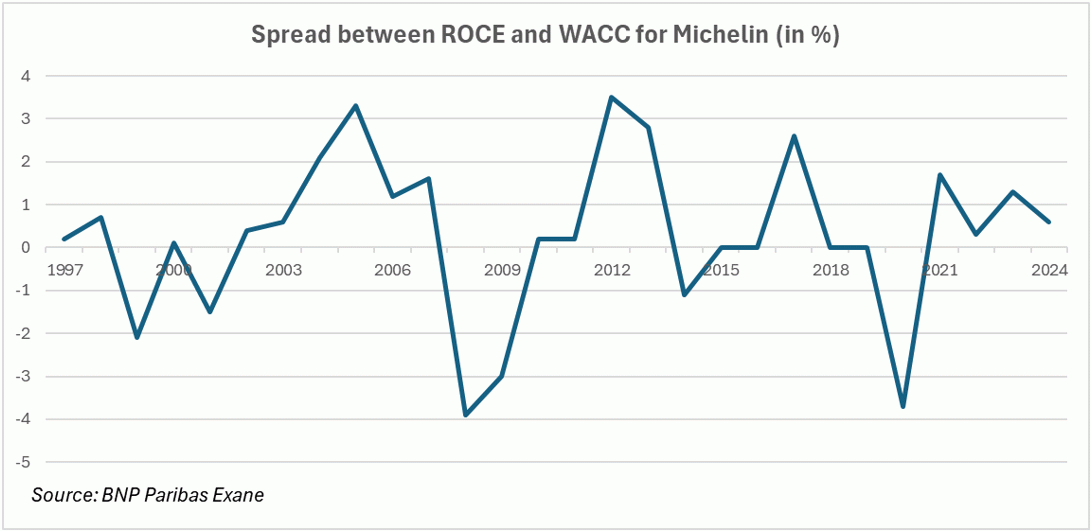
In fact, Michelin's layoffs in 2000 helped to rectify a delicate situation for the group, but did not enable it, given the intense competition in its sector, to achieve sustainable excess returns, since the average surplus remained stable at 0.3%.
One could argue that the losses incurred in Vannes and Cholet, or the insufficient profitability of these assets, are of little consequence to the Michelin group as a whole. Probably. But to repeat this reasoning, and why shouldn't it be repeated, is to put the company at risk. Not that this will necessarily lead directly to bankruptcy, but it weakens its self-financing capacity compared to its competitors and sets it on a downward spiral of underperformance which, over time, will lead to its marginalization or even its disappearance as an independent entity.
Admittedly, Michelin's estimated operating profit in 2025 may seem very high at €3,183m. But after tax at an average rate of 24% and on operating assets of €26bn, this gives an economic profitability of 9.1%, which is more or less equal to its current cost of capital of 9.3%.
The fact that accounting does not help in understanding corporate performance by including lenders' compensation in the income statement but not the cost of equity is certainly a major shortcoming in educating novices in this field.
We could turn the issue on its head and say that a company that had laid off employees would not be able to pay dividends the following year, as a punishment to satisfy the section of public opinion that is ill-informed on these issues.
The rapporteur initially raised this possibility before sidestepping it when we wanted to discuss it in depth.
This option would be less bad than the previous one, so to speak. But it raises at least two problems:
• What about subsidiaries of groups versus independent companies? If a subsidiary of a group has laid off employees and does not pay dividends to its parent company, the latter will have no difficulty, via a current account, withdrawing the cash necessary the following year to pay its own dividends. But the independent company will be bound by law and will not be able to distribute dividends. Should a significance threshold be set for groups, for example 10% of the workforce, and the law only apply in the event of redundancies above this threshold?
• What about foreign groups? Will we see the HSBC group stop paying dividends for a year because it has made redundancies in France? Or will we realistically limit ourselves to French groups alone, penalizing them once again in relation to their foreign competitors, who are not subject to this provision? It should be remembered that European banks suffered greatly in terms of their stock market status when the ECB prohibited them from paying dividends in 2020, even though they were well above their minimum regulatory capital requirements. Indeed, due to the customer effect, their shareholders are mainly interested in receiving dividends in order to meet their own constraints (pension funds, distribution funds).
* * *
Two final thoughts on this exchange:
• At no point did the rapporteur address the question of what problem this bill is supposed to solve, namely why France's unemployment rate is higher than that of its main economic partners: France: 7.3%, Italy: 6%, United Kingdom: 4.5%, United States: 4.2%, Netherlands: 3.9%, Germany: 3.5%, Poland: 2.7%.
What seems clear to us is that if this bill were to be adopted as it stands, the effect would surely be the opposite of what its authors sincerely intended. French companies would then have every reason in the world to set up their businesses outside France, exporting their products and services from abroad to France, to the detriment of employment in France.
• At no point did the rapporteur ask herself why, if this measure was so good, none of the countries around us had ever implemented it.
Due to a lack of basic economic knowledge, 65 senators reason as if France were protected by borders and customs duties as it was before 1957, and as if placing additional constraints solely on entities that create significant wealth in the country could reduce unemployment.
Judging by the rapporteur's final reaction, it seems that the aim is not to reduce unemployment, but to present a measure that will satisfy voters, at least temporarily. Since they are neither stupid nor blind, sooner or later they will be disappointed by the effects, which are the opposite of those expected but entirely predictable, and will fuel the extremist camps.
We believe that there is nothing to be gained by not educating one's fellow citizens when one is in a position to do so. We therefore reminded the rapporteur that inflation in France disappeared for 30 years when, in 1984, a socialist economy minister permanently abolished state price controls, which were supposed to curb inflation but in fact contributed to it. Similarly, unemployment cannot be combated by indirectly prohibiting economic layoffs on a large scale.
Statistics : The Forex market
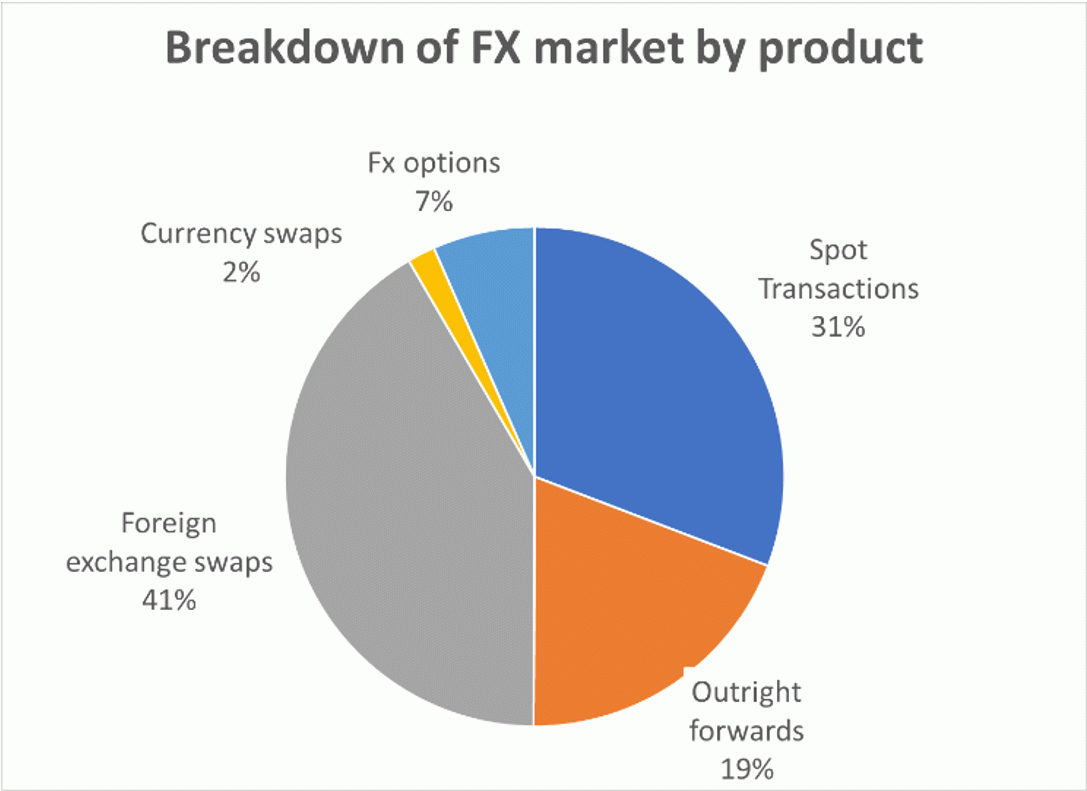
According to recent data released by the Bank for International Settlement (BIS) and observed in April 2025, the Foreign Exchange (FX) market represents daily average volumes of $9,595 bn split among the following products:
Source: BIS.
FX swaps represent the majority of the volumes with spot transactions accounting only for 31%.
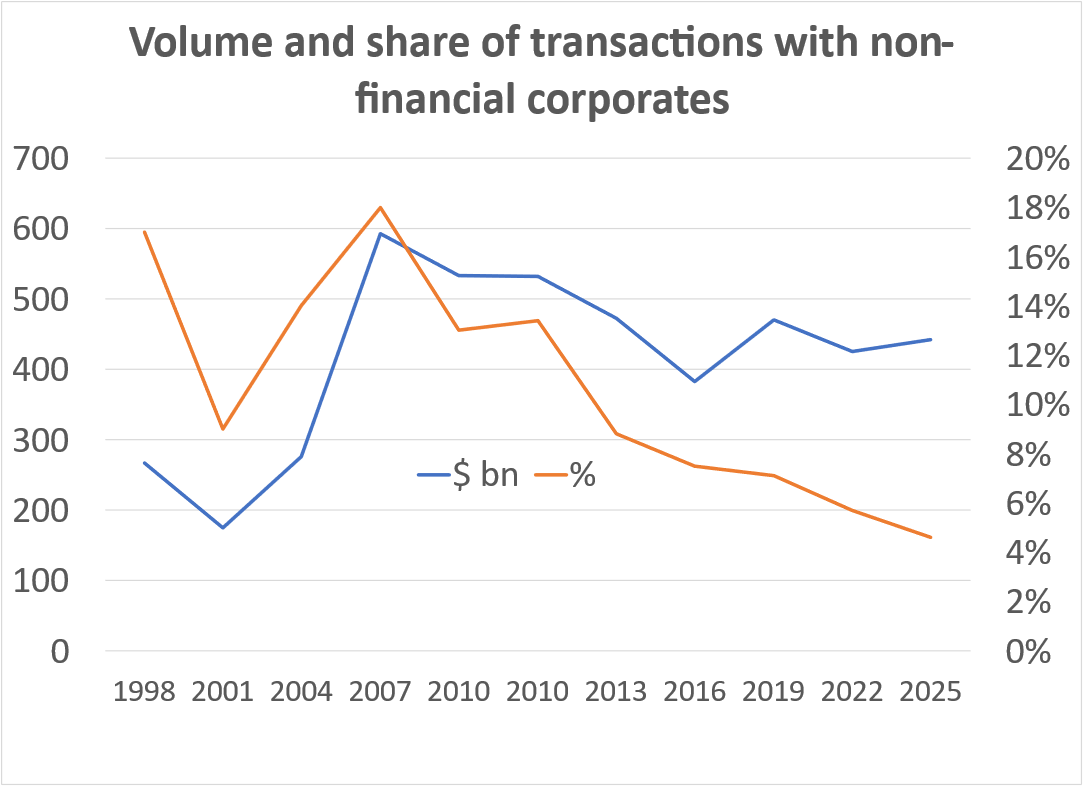
The volumes traded by corporates are relatively stable in absolute terms but their share has been decreasing since 2007 and represents now less than 5% of daily global volumes:
Source: BIS.
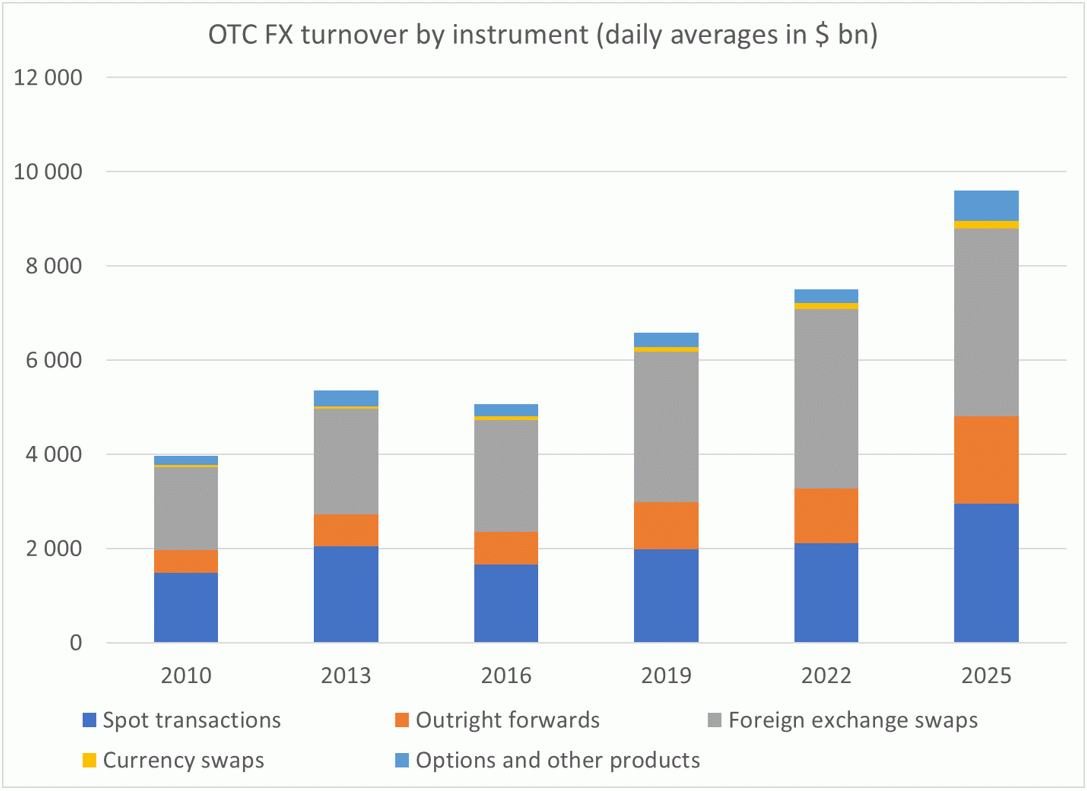
Volumes of transactions have more than doubled since 2010 (growing by 27% since 2002). Growth has been largely fed by the increase in swaps and forwards contracted by financial institutions:
Source: BIS.
New-York, London, Singapore and Hong Kong represent more than 75 % of transactions.
Most active currencies are the US dollar (89 % of forex transactions have a $ leg), the Euro (29%), the Yen (16%), the UK pound (10%), and the Renmimbi (8,5%).
Research : Investments by large companies: between the search for liquidity and tax optimisation
With the collaboration of Simon Gueguen, teacher-researcher at CY Cergy Paris Université
Academic studies on corporate financial assets face a technical challenge. While the amount and changes in these investments are readily available, their exact composition is only visible in the explanatory notes to financial reports. This data is therefore public, but unfortunately there is no comprehensive database that can be used to support empirical research.
Two researchers[1] sought to fill this gap by manually collecting this information themselves for the largest American companies. Their sample thus includes "only" 200 companies (non-financial), but some of these are giants in terms of financial investments. In 2017, Apple reached a record $260bn in financial assets, including $150bn in corporate bonds, an amount that would make it one of the five largest American banks. By exploiting this new database, the authors were able to analyse the composition and dynamics of these investments over a period of more than 20 years, between 2000 and 2022. In particular, their study covers the subprime crisis and the Covid crisis.
The main finding of this study is that the rationale for holding corporate bonds is largely separate from that for holding money market products. Tax considerations are the dominant factor driving corporate bond holdings. American companies that generate cash internationally purchase bonds locally and wait for repatriation opportunities such as the Trump administration's Tax Cuts and Jobs Act (TCJA) passed in 2017. As a result, between 2017 and 2019, total financial investments by large US companies fell by more than $400 billion (25% of the total), and this movement is almost entirely attributable to the resale of bonds and the repatriation of cash flows. Holdings of monetary products remained virtually unchanged over the same period.
Conversely, the COVID crisis led to the creation of liquidity reserves via money market products but had no impact on bond holdings. The entire increase in investments at the height of the crisis (in 2020) is attributable to money market products. As the objective was to build up a liquidity reserve, corporate bonds were not suitable (as their own liquidity fell during the crisis).
Corporate bonds and money market products therefore serve different purposes, and analysing holdings of "financial assets" without distinguishing between their nature does not provide a proper understanding of the total variations observed, particularly during macroeconomic events.
The split between these two types of products also has an impact on the risks faced by these companies in the event of interest rate fluctuations. During the bond market crash of 2022, Apple lost $9 billion (5% of the value of its assets). At the same time, Ford and Amazon lost virtually nothing, as the proportion of cash products in their total investments was twice as high.
Uncertainty and variations in cross-border taxation can thus have adverse effects. When taxation is high, companies use their accumulated cash reserves to purchase financial securities and wait for an opportunity to repatriate their funds under favourable legislation. As the objective is essentially fiscal, the aim is not to remain liquid and care must be taken to ensure that the company's profitability is not overly affected; companies therefore decide to accumulate corporate bonds. In doing so, they expose themselves to more interest rate risk than is reasonable. While the Apple case is emblematic and spectacular, the trend is strong across the entire sample, with corporate bonds accounting for nearly 24% of investments in 2017, compared with less than 9% in 2000 (it fell back to 17% after the Trump reform). In addition to its detailed analysis of the financial investments of large companies, this article provides an argument against changes in taxation on international flows.
[1] O. Darmouni et L. Mota, “The savings of corporate giants”, Review of Financial Studies, 2024, vol. 37-10, p. 3024 à 3049.
Q&A : How should the minimum cash reserves required by a regulator be treated in valuation works
Regulators of asset management companies require them to block a portion of their cash reserves corresponding to several quarters of their operating costs in order to ensure their solvency.
In this context, we believe it is logical to treat these sums not as cash available, but as an investment necessary for the business, similar to a fixed asset.
The sums thus blocked will not be included in the bridge from entreprise value to equity value in indirect valuation approaches.
Correlatively, the required year-on-year variations in the amount of cash blocked by regulation will be considered as investments and will therefore be deducted from the calculation of free cash flow.
Finally, the financial income generated on this blocked cash will be added to operating income. Otherwise, the value of the restricted cash would be completely ignored, as if it had fallen into a black hole. This asset management company would then be worth as much as a similar asset management company in every respect, but without any regulatory restricted cash, and therefore in breach of its regulator's rules, which is absurd.
New : Comments posted on Facebook
Regularly on the Vernimmen.com Facebook page[1] we publish comments on financial news that we deem to be of interest, publish a question and its answer or quote of financial interest. Here are some of our recent comments.
Size discount and illiquidity discount are like two sides of the same coin (September 8)
Eduniversal has sales of €4.6m and net income of €1.1m with 17 employees in the business school rankings. The company is listed on Euronext Access, formerly the Marché Libre, whose reputation Euronext sought to improve by giving it its name.
Unfortunately, a name change is not enough to make shameful practices disappear, as illustrated by the delisting of MAB before the summer. For this to happen, Euronext would need to devote time and use its powers. The delisting of Eduniversal on August 6 with Euronext's agreement is yet another unfortunate example of this.
The CEO and founder of Eduniversal, who owns 90% of the shares, chose an accountant paid €8,500 to value his company at €3.1m. This work contains several shortcomings that left Euronext unmoved, if indeed its services even read this valuation:
1/ A cost of capital of 19.5% for a company with a beta of 1 should set a red light when the average cost of capital in the economy is around 8%. The expert arrives at this truly unprecedented figure by adding a size premium of 10%. He does not refer to it as a liquidity premium, as this would be incongruous in a buyout offer that specifically provides liquidity to shareholders. But isn't the size premium for small companies just another name for a liquidity premium? After all, a small company will necessarily have low liquidity. But this so-called "size" premium is very useful in justifying the offer price, which otherwise would have had to be nearly four times higher with a cost of capital of 8%, or twice as high if 12% had been used.
2/ While the expert remembers to include cash available in the EBITDA multiples method to move from entreprise value to equity value, he forgets to do so in the DCF method (sic), thereby underestimating this value by 11%.
3/ All evaluators rely on recent certified historical accounts. In this case, the expert agreed to work with certified accounts, the most recent of which date back to 30 September 2023! In fact, Eduniversal extended its financial year, which was due to end on 30 September 2024, by six months, closing it on 31 March 2025. However, these latest accounts were available before the offer was launched on 6 August, as they are sent to the tax authorities within three months of the end of the financial year. An expert, who is not independent in name only, would have insisted on working on these accounts, which have been available since the end of June 2025, even if it meant delaying the launch of this delisting by several weeks, rather than working on the uncertified "provisional" accounts as at 30 September 2024. Who can be convinced that there was an absolute urgency to launch this delisting on 6 August, unless, of course, the accounts as at 31 March 2025 are better than the "provisional" accounts as at 30 September 2024?
AXA borrows money at a lower rate than the French Republic (September 17)
Around 70 major European groups, including Axa, have been borrowing at lower rates than the French government for several weeks now, due to the rise in the interest rate at which the French government borrows, which is itself caused by our collective inability to reduce the budget deficit to a level that ensures the sustainability of our nation's debt.
On Friday, the insurer's bond maturing in October 2030 yielded 2.74%, compared with 2.75% for the French government bond with a similar maturity. And yet, the government benefits from a liquidity premium that investors are willing to pay to reward the excellent liquidity of its bonds, this one has an outstanding amount of €59 billion. The liquidity of the AXA bond is much lower, with an outstanding amount of only €850 million, and buyers of these bonds tend to hold them until maturity (buy and hold). Without this liquidity premium enjoyed by the French government as a result of France Trésor's excellent management of the French debt market, the government would be borrowing at around 2.90% for a 5-year debt.
A comparison of this AXA bond with a similar maturity bond issued by Allianz shows that the borrowing rates of the two groups remain similar (2.72% for Allianz), even though AXA has a marginally lower rating (AA-, the same as France, compared with AA for Allianz and AAA for Germany). AXA is therefore not penalised by the deterioration in French government borrowing conditions. Nor is there any shift from sovereign debt to the debt of large French groups, which is hardly surprising given their much lower liquidity.
In OECD countries, it is very rare for groups to issue debt on better terms than their country of origin. This was observed briefly during the 2012 euro crisis, but concerned far fewer groups than today. This situation is of course unflattering, as it is generally observed in emerging countries, where government finances can be chaotic.
For the time being, this independence of large French groups from their government's debt is fortunate. Medium-sized groups also appear to be unaffected. For example, the yield on SEB's 2030 bond fell by 10 basis points this summer, as did that of AXA and Allianz, while the yield on 5-year OATs rose by the same amount.
Variable-rate bank loans indexed to €STR or Euribor should not be affected, as long as the short-term financing costs of French banks remain unaffected.
This will be less the case for individuals with future mortgage loans, whose interest rates are more or less indexed to long-term government bonds rates. Meilleurtaux has announced an average increase of 10 to 15 basis points in September for mortgage loans.
A good LBO is like a good ice cream: it can be enjoyed for longer than you might think (October 11)
And for PAI, you could even say more than 12 years.
- 2013: PAI mounts a secondary LBO on R&R Ice Cream
- 2016: merger with Nestlé's ice cream business in a 50/50 joint venture called Froneri
- 2019: creation of a first continuation fund to house part of its stake alongside investors from the 2013 LBO and new investors
- 2025: announcement of a second continuation fund
In twelve years, Froneri has become the world's second largest ice cream company, behind Unilever with €5.5bn in sales, 13,000 employees in 25 countries, and a 25% market share (2024 figures).
Froneri operates under licence for brands such as Häagen Dazs, Oreo and Nuii, as well as white label brands for distributors.
Its ROCE after tax of 9.4% is well above its cost of capital, demonstrating value creation, especially as goodwill and customer lists have been revalued on the balance sheet as acquisitions have been made, raising the bar even higher.
At the end of 2024, net debt had fallen to 4 times EBITDA, allowing Froneri to take on €4.4 bn in new debt in the form of a special dividend (dividend recap) financed by a high-yield bond issue (4.75% in euros and 6% in dollars maturing in 2032). These relative low rates shows the current strong appetite for risk in this segment of the bond market. It is true that Froneri, due to its sector, is one of the least risky issuers in the high-yield market.
Technically, this exceptional dividend should result in negative equity (€1.9bn at the end of 2024). However, as the assets are worth more than their book value (see its ROCE exceeding the cost of capital), there is no solvency issue.
PAI has just announced the creation of a second continuation fund, which allows investors in the first continuation fund to exit with capital gains or even reinvest alongside new investors. This also allows PAI to remain a shareholder in Froneri, while generating cash return for its fund investors. There is no better recipe for raising a new fund in the future and defying the current market slump in LBOs.
At €15 billion, the entreprise value represents 10.7 times EBITDA, which is not excessive given the low volatility of cash flows and barriers to entry of its activities. As for debt, it should be just over 6 times EBITDA, which does not seem worrying in this particular case.
The continuation fund is therefore not just a vehicle set up when a fund approaches its liquidation date without having managed to sell an asset due to a lack of appetite in the market at the asking price. It is also a tool for keeping a successful group that lends itself well to successive LBOs for longer than a typical LBO cycle, much like Picard in its day, but in this case with the same sponsor (PAI).
