Letter number 166 of July 2025
- TOPIC
- STATISTICS
- RESEARCH
- QUESTIONS & COMMENTS
- NEW
News : king equity great again or making European financial markets more attractive (2/2)
The first part of this article has been published in the June issue.
The profound scope of discounting and its consequences
However, past performance is not a guide to future performance, as required by law in all advertising for financial products. The purpose of this statement is to warn investors against extrapolating past performance into the immediate future, or against the temptation to think that a manager who has just beaten the market can continue to do so in the future.
But over time, and from a macroeconomic perspective, it loses its meaning. To understand this, let's go back to the fundamentals of the value of a financial security, which is the discounted value of the cash flows it is likely to generate in the future. Imagine that, for educational purposes, we are proposing to pay you the sum of 110 in a year's time, provided that you buy this promise from us today, at a price that is the subject of this exercise. To simplify the calculations, let's assume that you want a 10% rate of return on your investment. At what price are you prepared to buy this promise from us today?
Normally you would answer 100, and from a technical point of view you could add that this is the result of discounting a future sum (110 in one year's time) to determine its current equivalent, i.e. its present value. As soon as you have depreciated the future cash flow in order to acquire it today at a lower price than its future nominal amount, you guarantee yourself an increase in the value of your investment. Discounting future cash flows therefore means obtaining a return on your investment; and this is what has been done in finance for centuries, hence the shape of the historical curves seen above.
In the case of bonds, this profitability is fairly certain, since unless the issuer goes bankrupt, the expected interest and repayment flows will be there. In the case of equities, the flows do not depend on a commitment to pay a fixed sum, but on fluctuating flows, which depend on the financial health of the company. Profitability is therefore more variable, because future cash flows can be underestimated (as in 2020, for the strength of the post-covid recovery), or overestimated (as in 2019 before the covid, which was not on any radar). The result is periods of boom and bust that correct themselves over time, as David Le Bris's chart shows. In the long term, the average triumphs over standard deviations.
The operational consequence of this is that it is in the individual's financial interest to have:
- precautionary savings to deal with the hazards of everyday life, invested in cash or short, low-risk bonds;
- then savings with a time horizon of a few years for major projects such as buying property or children's higher education, invested in bonds;
- and most of the remainder, particularly with a view to retirement or inheritance, is best invested in equities diversified by sector and internationally.
* * *
What can be done to make European financial markets more attractive?
In 2024, several European countries passed laws to make their local financial markets more attractive. In France, for example, companies listed on the stock exchange will be able to grant multiple voting rights (up to 25 for one share) to shares held by their founders for a maximum period of 15 years, more flexible procedures for carrying out capital increases without pre-emptive rights, the digitisation of international trade finance activities, the ability to trade fractions of shares, bonds or fund units, etc.
Let us say that these measures fall far short of what is at stake and focus almost exclusively on issuers. They are not likely to change the incentives for our compatriots to continue to invest mainly in debt products. The Banque de France estimates that by the end of 2023, the French will have assets worth around €14,000bn, of which €6,185bn are in financial investments, with the remainder mainly in property assets. Of these financial investments, €1,363bn is invested in unlisted shares and other holdings, corresponding mainly to the work tools of entrepreneurs and managers. The freely-determined balance of €4,822bn is made up of 77% in debt securities: €1,483bn in euro accounts for life insurance and pensions, €751bn in sight deposits, €565bn in tax-free passbook savings accounts, €396bn in term deposits and ordinary passbook savings accounts. The remaining 23% of savings, or €1,017bn, is invested in equities, around half of which via unit-linked life insurance policies or pension plans.
Tax is undeniably a major, if not often the only, criterion of choice for many savers. For historical reasons, the French tax system gives massive advantages to investments in debt securities.
With a life insurance policy, a couple can invest €305,000 in a euro policy (invested mainly in bonds, as the insurer must guarantee the capital), and withdraw the interest at 3% each year at a tax cost of just €1,574. And if the couple dies with at least two children, the policy will be passed on completely free of inheritance tax.
In addition, this same couple can invest €22,950 per person in their household, i.e. €91,800, in passbooks (Livret A), and €24,000 in LDDS which are totally liquid and tax-exempt.
This means that this household can invest a total of €420,800 in financial assets without incurring any significant tax, without taking any capital risk and with total liquidity.
If it wanted to invest this sum in shares, it could open PEA accounts (but with a limit on investments, unlike life insurance), and without any specific exemption from inheritance tax or reduced tax rate beyond the allowances.
This €420,800 corresponds roughly to the 8th decile of French households' assets before debt, including property. Otherwise, three quarters of French households have every tax incentive to invest in debt, which they do, and marginally to invest in equities: more than 74% of life insurance and pension contracts are invested in debt (euro contracts).
As long as this distortion continues, where risk-free savings are not taxed while risky savings are, there will be no deep financial market in France. Households will continue to favour tax-free investments in debt, even if this is not in their long-term financial interest, or that of the country, and will continue to ignore equity investments on a massive scale. And promising start-ups and major groups will continue to seek capital on the other side of the ocean - if they don't settle there permanently.
So, if the public authorities really want to make the financial market more attractive, we suggest that they reserve the tax advantages of life insurance investments solely for those invested in equity capital, with the others being subject to the common system, which is in no way spoliatory (maximum 30% flat-rate). As for regulated savings accounts, there should be a ceiling on the amount per household, for example at €33,200, which is the gross wealth of the 3rd decile, so as not to create a windfall effect for those who have the financial and cultural means to manage their assets.
At the same time, an educational effort similar to that made by the Swedes 40 years ago, well before the arrival of the Internet, which makes things much easier, must be made towards households, and more structurally towards teenagers, to integrate into their school curriculum courses in the form of MOOCs enabling them to learn from competent teachers the basics of finance: capitalisation, discounting, present value, characteristics of shares and debts, the main financial investments and the ABCs of personal asset management. It seems to us that an certificate of minimum financial knowledge would be as useful to young people in life as the school road safety certificate which must be obtained at collège in order to pass the driving test later.
Finally, and more symbolically, we suggest that Euronext, which has already merged its 7 stock market platforms into a single one, should stop presenting itself as 7 different entities in its 7 countries (Belgium, France, Ireland, Italy, Norway, the Netherlands and Portugal) and instead appear as a single Euronext with flagship indices (Europe 200? Europe Small and mid?, etc.) replacing the CAC 40, the MIB 40, the BEL 20, etc., and with a view to eventually incorporating all the major stocks listed in Europe, even if it is not yet possible to merge with the other European stock exchanges in Frankfurt, London, Madrid, Stockholm and Zurich.
* * *
We are perfectly aware that this outlined programme can only be implemented and produce its effects over time, as the Swedish experience shows. And that at a time when the extremes seem to be seducing a large part of the public with measures that are perfectly demagogic and destructive, charting the course of reason may seem futile. But after the noise and the fury, sooner or later the path of reason will return, through necessity or lucidity. And as educators, we have the weakness to think that we are training our students and readers not just for the next few weeks, but for the next few decades.
Rome wasn't built in a day, and neither was your Vernimmen, which is celebrating the fifty-first anniversary of its first publication this year.
Statistics : World corporate income tax rates
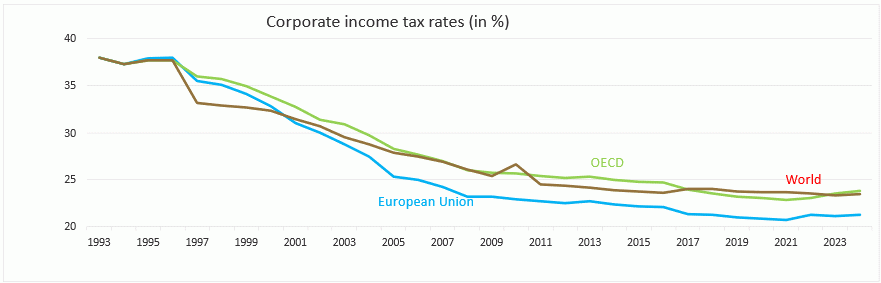
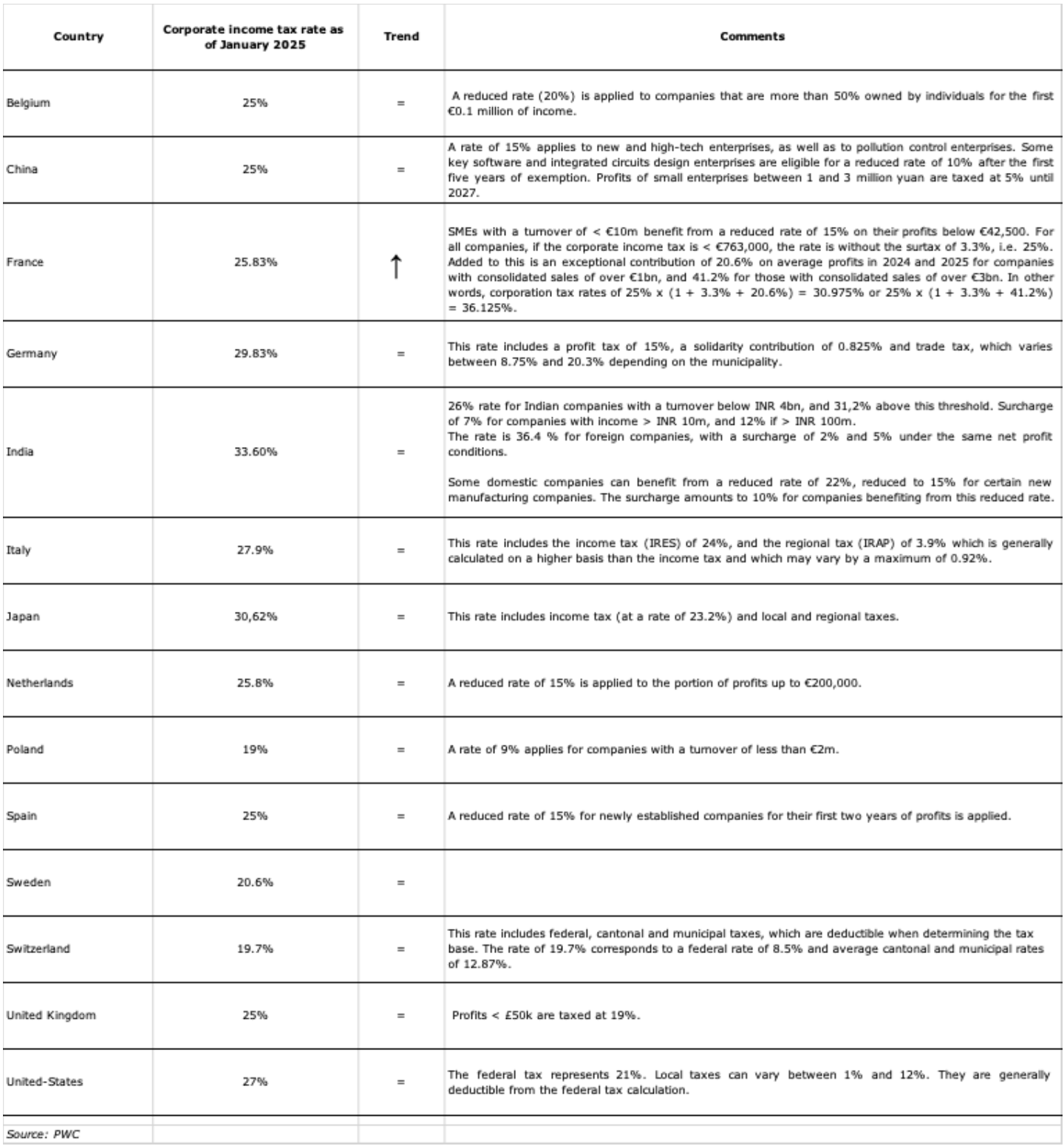
Corporate income tax rates around the world rose very slightly in 2024, averaging 23.51% (23.37% in 2023). This is also the case in the OECD countries, which have begun to raise their rates from the lowest reached in 2022 (23.04%) to 23.85% in 2024.
Research : The survival of teams of inventors during bankruptcies
With the collaboration of Simon Gueguen, teacher-researcher at CY Cergy Paris Université
Company failures are one of the mechanisms by which innovation spreads. Schumpeter's famous creative destruction, according to which obsolete economic structures must disappear to allow new technologies to emerge, also applies to businesses. However, even when it comes to innovation, each individual failure often results in a loss of human capital.
This month's article looks at this phenomenon. It deliberately sets aside the social aspects (consequences for all employees) and the purely financial aspects (creation and destruction of value) to examine a specific point: what happens to research teams after a company goes bankrupt?
The authors are interested in "collective human capital", an intangible asset made up of acquired coordination skills between researchers, which is only truly transferable if the team is maintained after bankruptcy. The simplest way to achieve this is to maintain part of the structure by buying another company. More difficult is to reconstitute the team via the labour market. A company wishing to take on the entire team may come up against contractual or regulatory obstacles (non-competition in employment contracts), or simply personal obstacles if some members of the team find it difficult to relocate. The article shows that the dissolution of teams leads to a significant drop in innovation, and that the market for corporate control plays an important role in preserving collective human capital.
To arrive at an empirical measure of these effects, the authors cross-referenced several databases. The sample consists of US companies, both listed and unlisted, that went bankrupt between the early 2000s and 2015. If the sample may seem a little old (even though the article is published in 2024), this is because the authors need hindsight to observe what happened to the teams after the bankruptcy and to measure the impact on innovation. The authors are also faced with a frequent difficulty in finance: the risk of confusion over the meaning of causality. For example, if a team dissolves after bankruptcy, it may be that it has lost effectiveness. In this case, the loss of efficiency would be one of the causes of the bankruptcy rather than one of its consequences. To limit this risk, the authors implement a series of robustness tests. For example, they check that the same effects are observed in bankruptcies that cannot be caused by a lack of innovation.
The first quantified result of the article is a measure of the loss of researcher productivity following bankruptcy. Over a 10-year post-bankruptcy period, the decline is around 3%. Most of the decline occurs in the first three years, whereas no decline is observed before bankruptcy. The study shows that this decline can largely be explained by the dissolution of teams. The loss of productivity is less marked for researchers behind patents filed without co-authors. On the job market, researchers who worked solely in teams were also less likely to find a new position within two years (the difference was 18%).
The second notable result concerns the labour market and the market for control of companies. To preserve collective human capital, the ideal case is the takeover of the company by an industrial (non-financial) buyer. In this case, no loss of productivity is statistically observed. With this result, the authors show that it is not bankruptcy itself that destroys collective human capital, but the resulting dissolution of teams. The loss is observable but limited when the buyer is financial (essentially private equity funds). It is greatest in the case of liquidation. The labour market can also help to preserve teams, but there are many difficulties, and legislation in some American states even prevents them from being reconstituted.
Finally, the article highlights a sub-area of human capital that is particularly difficult to measure: the collective dimension of teamwork. The preservation of teams is a determining factor in maintaining the capacity to innovate. The authors stress one point: the crucial role of the market in controlling companies and the labour market in this respect.
One further point: the article studies collective human capital and its preservation, but ignores the financial effects. The value of collective human capital is not measured, and the notions of profitability and financial risk are absent from the article. Nevertheless, the article is published in a major finance journal and its results pave the way for future research. As the authors of Vernimmen like to remind us, there's more to life than finance!
Q&A : Who said what?
In order to keep in touch with finance over the summer break, we suggest that you assign an author to each quotation:
- 1. When you value a company, you have to have faith in your value, and you have the faith that the price will correct to that value.
- 2. Clocks are made to tell time and tariffs to tell costs.
- 3. When you're most popular is probably when you're reaching the top of the cycle.
- 4. It was the human side, in practice the negotiating side, which attracted me to banking,
- 5. The imbalance between rich and poor is the oldest and most deadly disease of all republics.
- 6. Experience shows that it is unwise to trust human greed when it has the opportunity to enrich itself at the expense of others.
- 7. But dividends are used to fund companies!
- 8. Gold is money. Everything else is credit.
- 9. The hotter the environment, the more people look at something like crypto and they go from saying it's possible it will work to it's sure it will work. And that's when you get in trouble.
- 10. Bitcoin is a Ponzi scheme: you can only make money if you find a bigger fool to buy your Bitcoins for more than you paid for them.
And now the authors:
Marcel Boiteux, former CEO of the French electricity group EDF
Court in Columbus, Ohio, during a trial against the Standard Oil Company of Ohio in 1890.
Aswath Damodaran, professor of finance with Stern Business school NY, specialist of valuation issues
Jeremy Grantham, investor
Ken Griffin, Citadel's founder
Eric Lombard, then CEO of CDC, the French wealth fund
Howard Marks, investor and founder of Oaktree Capital
John Pierpont Morgan, American banker of the 19-20th century
Plutarch, Roman historian of the 1st century AD.
Siegmund Warburg, European banker of the 20th century
The answers are given at the end of the Comments section.
New : Comments posted on Facebook
Regularly on the Vernimmen.com Facebook page[1] we publish comments on financial news that we deem to be of interest, publish a question and its answer or quote of financial interest. Here are some of our recent comments.
Value or premium, which comes first? (19 July)
Unlike the chicken and the egg, this question has a simple answer. In a takeover bid, experienced investment bankers first determine the value of the target for their client and then deduce the premium resulting from the comparison between this value and the share price.
Novices, on the other hand, are content to lazily add a standard premium (e.g. 35%) to the latest share price to determine the offer price. They then run the risk of a rebellion by shareholders who know how to count, and of the offer failing.
The investment banker's role in valuation is therefore not simply that of an Excel wizard, as the naive might think. He must educate his client and not waver in the face of his greed or ignorance; and convince him, if he wants to achieve his ends, that he must pay the price rather than fail to cross the threshold for a takeover or delisting. This is where the most professional people come into their own.
Recent examples on the Paris stock exchange demonstrate this:
- NDK (advised by Crédit Agricole du Languedoc) on Parot: a premium of +243% on the three-month average price, a price corresponding to the multi-criteria value for this small, illiquid stock that is not followed by financial analysts.
- Talan (advised by ODDO BHF) on Micropole: a premium of 190%.
- When the Arnault group (advised by Crédit Agricole CIB) offered €44,000 per Financière Agache share, to acquire the 2,189 shares it did not own (0.07% of the capital), to take this little-known holding company out of LVMH's control for good, against an acquisition price of €2,500 to €3,500 (on 41 shares in a run-off) in the previous 12 months. A premium of 1,157% (sic). A record, no doubt. But quality has never been cheap.
Sabadell, never better than under pressure (28 July)
The Catalan bank presented its strategic plan on Thursday to help it escape the clutches of BBVA, which launched a hostile takeover bid more than 14 months ago. As it stands, and without a revision of the parity, this offer has little chance of succeeding, since BBVA's bid is 13% below Sabadell's share price.
To convince its shareholders not to tender their shares to BBVA's offer, Sabadell has promised to return all the equity generated by its results in excess of 13% of its risk weighted assets (CET1 ratio), through dividends (for 60% of the results) or share buybacks for the balance. 13% is nothing to sneeze at, since the prudential minimum is 9.4%; BBVA is at 12.8%, and BNP Paribas at 12.5%.
This is the heart of the capital allocation process.
Sabadell's managers and shareholders consider that they are comfortable with a financial structure in which their bank's risk weighted assets are financed with 87% debt and 13% equity. Keeping equity in excess of this 13% inevitably means investing it in risk-free monetary assets (which are not included in the calculation of the CET1 ratio), as it will not be able to grant additional credit to its current customers or to new ones (which would make this excess equity disappear).
Of course, it would be preferable for Sabadell to use its equity capital in excess of the 13% ratio to grant new loans. But trees don't grow on trees, and in a mature sector like universal banking in Europe, there are physical limits to the expansion of a loan portfolio, unless you accept bad risks. It is therefore preferable to return this new equity, generated by the results, to Sabadell's shareholders, via dividends or share buy-backs; rather than using it to destroy value, either through losses on defaulted loans, or through investments that are certainly risk-free but with a rate of return well below that demanded by the shareholders.
It is up to the shareholders to reinvest this equity capital, which Sabadell does not need, in companies which do need equity capital to finance their expansion into new markets. For example, by subscribing to the capital increase of Iberdrola, the Spanish energy company, which on the same day raised €5bn to continue its expansion in the construction of electricity networks, particularly in the United Kingdom and the United States.
Circulating money is the best way of ensuring that pockets of inefficiency and waste do not form, and that those who innovate, in developing or mature sectors, find the equity capital they need. Dividends and share buy-backs are just the tools we need to achieve the best possible allocation of capital.
New : Answers to Who has said what?
- 1. When you value a company, you have to have faith in your value, and you have the faith that the price will correct to that value. Aswath Damodaran
- 2. Clocks are made to tell time and tariffs to tell costs. Marcel Boiteux
- 3. When you're most popular is probably when you're reaching the top of the cycle. Ken Griffith
- 4. It was the human side, in practice the negotiating side, which attracted me to banking, Siegmund Warburg
- 5. The imbalance between rich and poor is the oldest and most deadly disease of all republics. Plutarch
- 6. Experience shows that it is unwise to trust human greed when it has the opportunity to enrich itself at the expense of others. Court in Columbus
- 7. But dividends are used to fund companies! Eric Lombard
- 8. Gold is money. Everything else is credit. J.P. Morgan
- 9. The hotter the environment, the more people look at something like crypto and they go from saying it's possible it will work to it's sure it will work. And that's when you get in trouble. Howard Marks
- 10. Bitcoin is a Ponzi scheme: you can only make money if you find a bigger fool to buy your Bitcoins for more than you paid for them. Jeremy Grantham
