Letter number 169 of December 2025
- TOPIC
- STATISTICS
- RESEARCH
- QUESTIONS & COMMENTS
- NEW
News : Capital increases without preferential subscription rights of listed companies carried out by ABB
ID Logistics, a rapidly growing logistics group (as evidenced by its P/E ratio of 45), which had a market capitalization of €2.471 million on September 4, 2024, carried out a €135 million capital increase that evening by removing the preferential subscription rights enjoyed by its shareholders, using the authorization granted to it by the general meeting (which is controlled by its CEO and majority shareholder).
Five trading days later (allowing time for the dust to settle), ID Logistics' market capitalization, despite being inflated by the €135 million capital increase, was only €2.446 million, rather than €2.471 + 135 = €2.606 million, even though the market remained relatively stable over this period (–0.9% for the CAC 40 index). The new shares, which represent only 6.1% of the shares on the morning of September 4, were placed with hedge funds, institutional investors, and the founder, following the accelerated construction of an order book, at a price representing a 10.4% discount to the closing price on September 4 (€360 vs. €402).
A quick calculation shows that the loss incurred by shareholders who are unable to participate in the capital increase because the preemptive subscription rights have been waved is 0.5%, which is negligible in this transaction, where only 6.1% of new shares were issued at a discount of 10.4%. However, the share price fell by 6.7% in five days, instantly wiping out more value than the proceeds of the capital increase itself!
More than a year later, while the SBF 120 index, to which ID Logistics belongs, is up 9%, the latter's share price (€394 on December 12) is still down 2% from the €402 price immediately preceding the capital increase, and this despite the fact that the founder and CEO's participation in the capital increase sent a positive signal.
Is this situation contingent and specific to this example, or is it more generally found in these fundraising operations without preemptive subscription rights and carried out by ABB (Accelerated Book Building[1])?
This is the question that two of our finance majors at HEC (MIF program), Daniele Masiello and Alberto Lombardo, explored in their research thesis under our supervision[2].
They reviewed all ABBs registered in Europe in 2022, 2023, and 2024, representing 427 transactions in 19 countries and 28 economic sectors. Seventy-seven percent of these ABBs involved less than €100 million, and 4% involved more than €400 million.
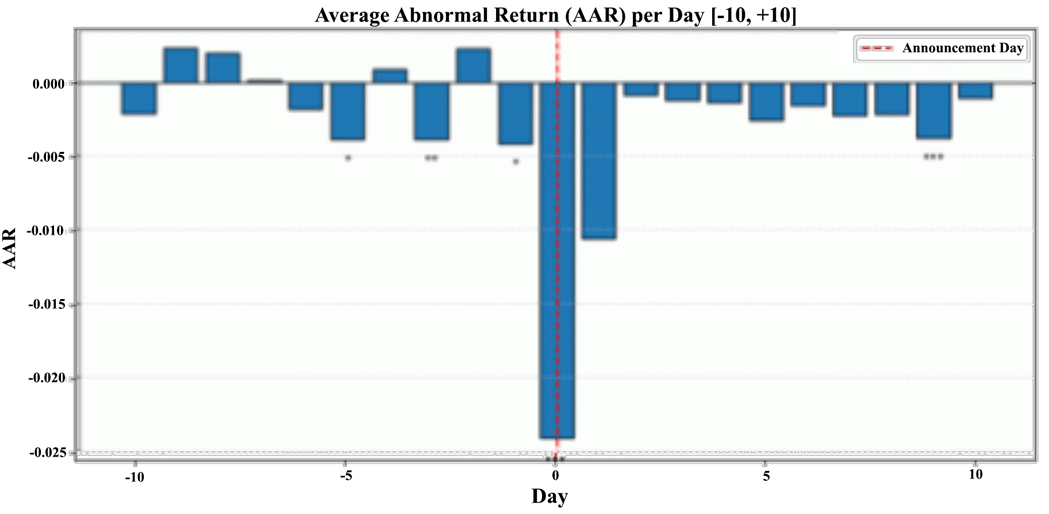
The conclusion of their observations is clear: in the vast majority of cases, the completion of an ABB results in a decline in the share price in absolute terms, and also in relative terms when market fluctuations during this period are taken into account. This is illustrated in the graph below:
Source: Alberto Lombardo, Daniele Masiello.
The variations in prices 10 days before the share placement and 10 days after were studied. It was observed that abnormal returns, i.e., daily differences between the variation in the share price that will be subject to an ABB and the index, were random before the ABB, with as many days of negative returns as days of positive returns. However, in the 10 days following the ABB, they became negative 10 days out of 10.
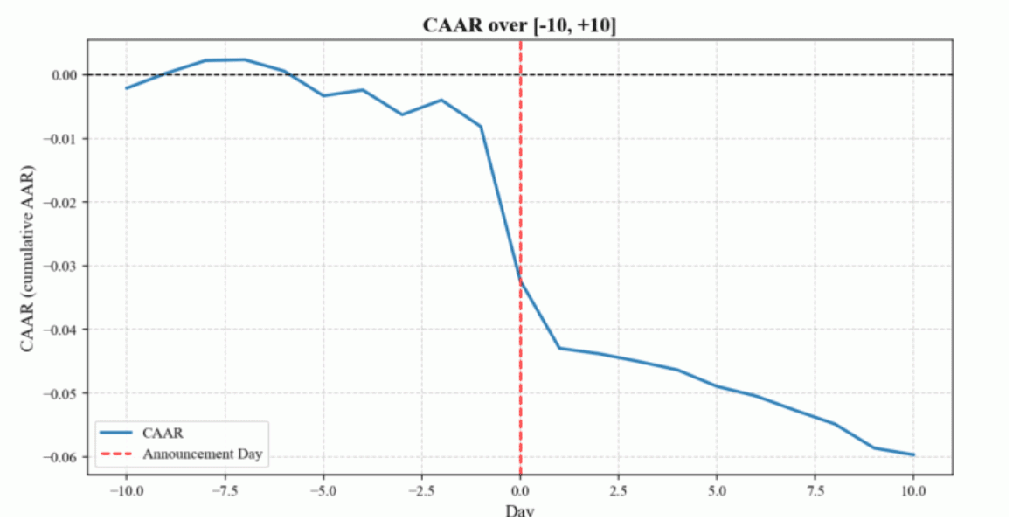
In other words, the decline in prices induced by the ABB investment is not just temporary after the share placement, but extends over several days, causing the cumulative loss to grow and reach an average of 6% 10 days after the ABB:
Source: Alberto Lombardo, Daniele Masiello.
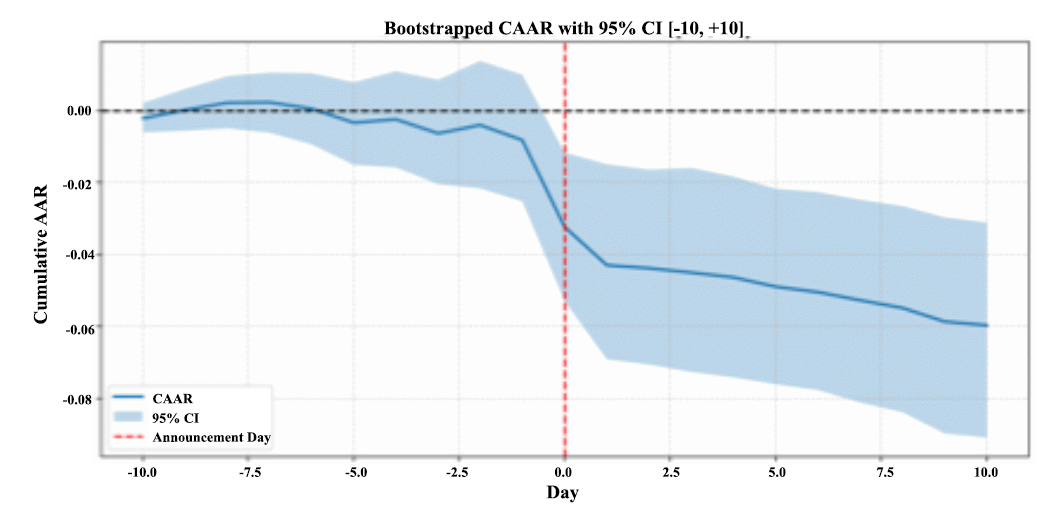
This average of 6% does not hide a wide dispersion, since 95% of observations fall within this blue corridor, which after 10 days shows price declines of between -3% and -9%:
Source: Alberto Lombardo, Daniele Masiello.
How can this situation be explained?
Let's take the example of ID Logistics again.
The main objective of the bank or banks in charge of the placement by ABB is not to delay! In such an operation, time is against those who have to sell securities for two main reasons:
- there is always the possibility of an unforeseeable event disrupting the market, such as a regional American bank suddenly going bankrupt, or a Middle Eastern potentate deciding to reduce his country's oil production;
- the more time passes, the more investors will realize that a share placement is underway and that it is not going very well (since there has still been no press release announcing its success). Some will start to short sell the stock, betting that they will be able to buy it back cheaper in the near future, given the difficulties of the share placement, which are thus cumulatively increased.
Therefore, when hedge funds come forward or respond positively to solicitations from underwriting banks, the latter do not necessarily turn them down, even though they know that hedge funds are not long-term, medium-term, or even short-term investors, but rather very short-term investors in this type of transaction.
Thus, in the ID Logistics example, some of the investors who subscribed at €360, the price resulting from the order book construction (remember that the previous day's price was €402), rushed to resell the shares the next morning at €375, to pocket the difference and move on to other things. This is evidenced by the trading volume on September 5, which was 12 times higher than the average for the previous three days.
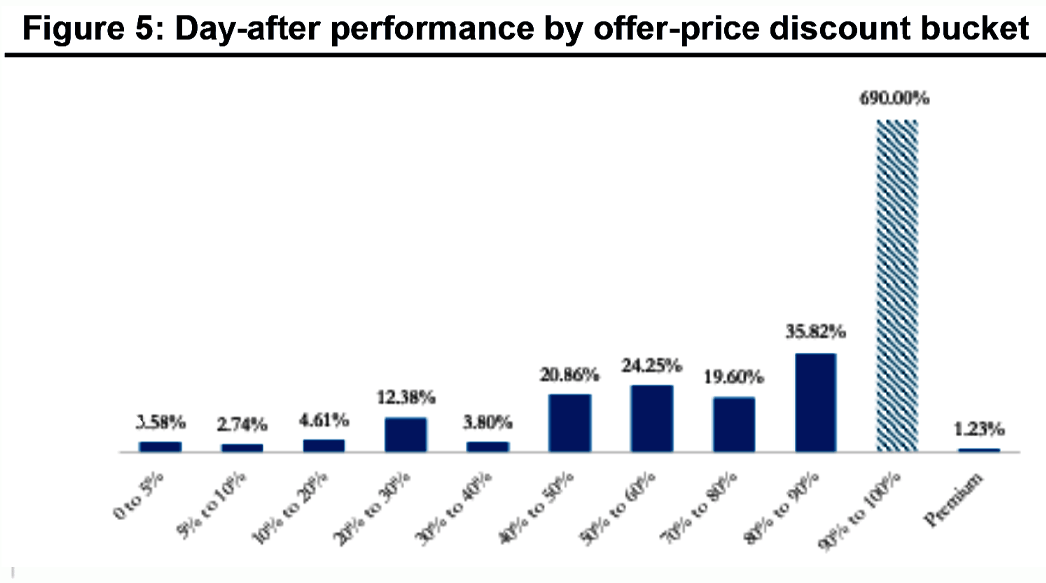
The study by A. Lombardo and D. Masiello shows that hedge funds always come out on top in this game, as they did with ID Logistics. Regardless of the discount granted in the ABB, the first price quoted after the placement is above the placement price (€375 versus €360 in ID Logistics example):
Source: Alberto Lombardo, Daniele Masiello.
Thus, when the placement discount is between 0 and 10% (64% of observations), the share price post the ABB is approximately 3% above the placement price. The average gain for hedge funds participating in ABBs was therefore 3% in one day between 2022 and 2024 (4% for ID Logistics).
And what about shareholders who do not participate in the share placement?
Either because they do not have the financial means to do so, or because their stake is too small to be contacted by the underwriting bank(s) during the few hours that an ABB lasts, knowing that an ABB is always launched after the stock market closes.
If they wish and are able to do so, they can compensate for the reduction in their stake in ID Logistics as a result of this capital increase by acquiring shares on the market, but at around €375, rather than €360 as the participants in the placement and the founder were able to do.
And even if one day ID Logistics' share price returns to its level prior to this capital increase, the fact remains that the latter instantly reduced its value by 6% and that any future increase will apply to a share price that is 6% lower.
This 6% drop may seem small—let's not quibble over 6%, one might think! But in reality, it is huge when compared to the funds raised by the placement, which represented 5.5% of ID Logistics' market capitalization. It is therefore of the same order of magnitude as the additional equity capital brought in by this operation when we think in terms of value, as any good financier should!
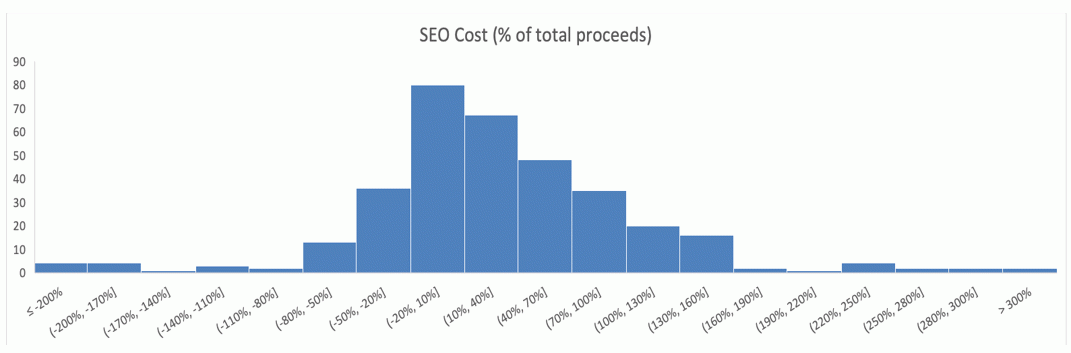
Lombardo and D. Masiello show that between 2022 and 2024, in Europe, the average decline in value resulting from an ABB placement was 29% of the amount of funds raised. But this average hides significant dispersion, with ID Logistics at over 100%, which is far from being an isolated example:
Source: Alberto Lombardo, Daniele Masiello.
The average cost of these transactions is therefore very high: it is a bit like a bank charging you a loan origination fee of 29% of the loan amount for a bank loan!
* * *
This helps explain why small shareholders dislike capital increases with the removal of preferential subscription rights, even if they are unlikely to be aware of the financial aspects we have just outlined. We believe they are more sensitive to the psychological aspect of being excluded from the possibility of continuing to finance their company, as if they were undesirable.
We hope that the CFOs of listed companies are more aware of the transfer of value induced by most ABBs, to the detriment of their shareholders and to the benefit of the participants in the placement, whether they are very short-term or long-term investors.
A. Lombardo and D. Masiello show that between 2022 and 2024, the smaller the size of the placement, the greater the discount, and the greater the discount on the placement, the greater the decline in the share price. It could be argued that, for small-cap companies (77% of ABB were less than €100 million) that resorted to a capital increase through ABB, there were probably no other alternatives for raising equity capital, since their current shareholder pool is likely to be too small to provide it, making a transaction with pre-emptive rights difficult.
Conversely, the low number of large transactions exceeding €400 million (17 in three years across Europe) shows:
- that CFOs are aware of the very high cost of this type of transaction; and
- that the size of the free cash flow of most listed companies (due to higher margins) bolsters their self-financing and internally generated equity, making it less necessary to tap the market, except for M&A transactions.
[1] More on ABBs in chapter 25 of the Vernimmen.
Statistics : Securitisation in Europe and the US
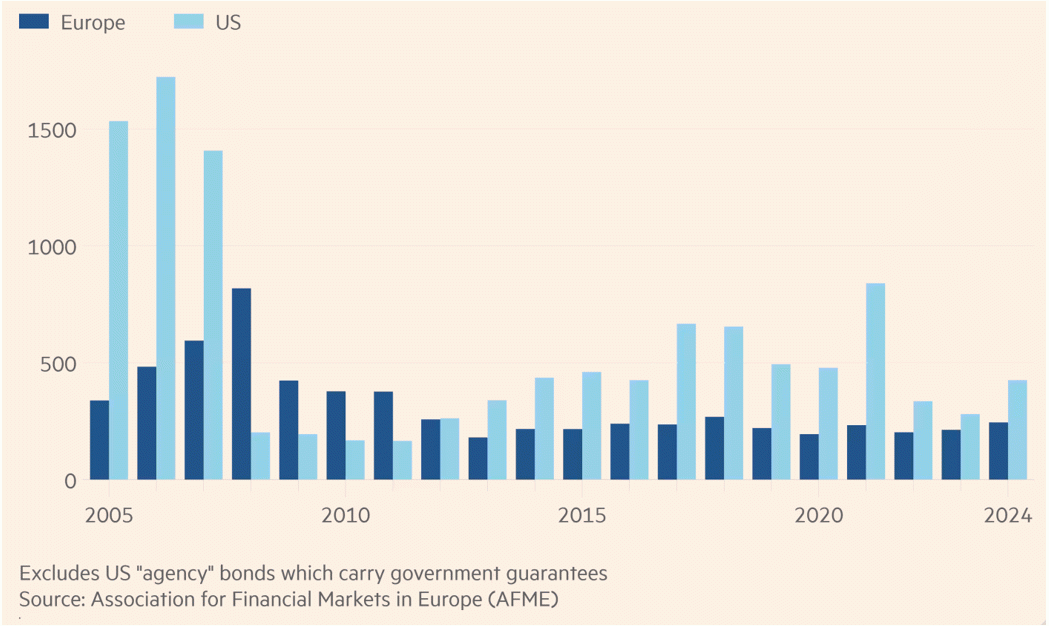
Published initially by the Financial Times, this graph shows there is still a long way to go to catch the volumes of securitisations achieved before the great financial crisis, assuming this is a healthy objective per se, which we are not sure of given the amount of deceiveness it supposed.
Research : Payment terms, predictive signals of stock market returns
With the collaboration of Simon Gueguen, teacher-researcher at CY Cergy Paris Université
Anyone who has encountered financial analysis in their studies or in practice knows the importance of changes in working capital in generating cash flow. When an increase in working capital consumes most of the cash generated by the business, or conversely, when a decrease in working capital is the main source of cash flow, a careful analysis of the various components of working capital (receivables, inventories, payables) is necessary in order to make a preliminary assessment prior to forecasting. This month's article[1] focuses specifically on one of the components of working capital: accounts payable.
In the United States, accounts payable represent about a quarter of total corporate debt and, more importantly, the largest portion of short-term financing (three times more than bank loans). This means that non-financial companies provide most of the short-term financing for businesses. However, as the authors of the article explain, the reporting requirements for listed companies in this area are limited. Financial statements only indicate the amount of accounts payable, but not the age of these debts, let alone the payment terms applied by the company to its suppliers.
Changes in accounts payable can be exploited, but they may reflect factors other than delayed or advanced payments (changes in business activity, changes in credit terms, etc.). If payment terms are relevant information for stock market performance and this information is difficult to access, there is potentially a market inefficiency that can be exploited on the stock market. This is what the authors demonstrate, proposing winning strategies for investors who have access to this information.
The authors use a private database (provided by Dun & Bradstreet) on companies' payment terms. This data is more comprehensive than that contained in accounting documents. It includes, for each company, actual and aggregated payment terms on a monthly basis. In particular, Dun & Bradstreet establishes a score indicating the reliability of each company in meeting payment deadlines, known as PAYDEX. This score is the main variable of interest in the article.
The sample consists of more than 7,000 listed US companies with a monthly PAYDEX between 2006 and 2019. It should be noted that the PAYDEX is constructed from information on only a small portion of each company's accounts payable, namely those owed to suppliers participating in the study. This is a limitation of the article, but the authors verify that no obvious selection bias appears to explain the results obtained.
The first idea is to use sudden changes in payment terms as an indicator of a company's financial situation. The strategy consists of investing in a long/short stock portfolio: buying shares in companies whose PAYDEX is increasing (faster payments) financed by selling shares in companies whose PAYDEX is decreasing. The authors achieve a return of 18 basis points (per month) on this zero-investment strategy. Often, achieving abnormal returns in research articles helps to corroborate a model or hypothesis, without the strategy necessarily being executable. In this case, the authors show that the spread is sufficient to cover transaction costs and cannot be explained by risk-taking in the long/short strategy. An equity investor with access to PAYDEX could therefore effectively benefit from it. From an academic perspective, the result supports the idea that payment terms to suppliers provide relevant information beyond that usually available to investors and analysts.
The second idea concerns the ability of certain companies to maintain consistently long payment terms, even when economic conditions fluctuate. While a sudden increase in payment terms is an indicator of difficulties (as discussed above), consistently long payment terms suggest a structural advantage linked to strong bargaining power. This time, the long/short strategy consists of buying shares in companies that have this ability and selling those in companies that do not. The abnormal monthly return obtained is even higher than with the first strategy: 35 basis points per month. However, part of this gain is linked to risk-taking. The authors note that when tensions increase along the supply chain (e.g., due to logistical problems), the companies with the strongest bargaining power are the ones that suffer the most. Those that are generally subject to negotiations can find opportunities for growth by responding to specific needs. The crisis offers them “real options” that offset some of the difficulties. This second strategy remains financially profitable and requires zero investment, but it is not without risk.
Overall, the study shows that payment terms are predictive indicators of stock market returns. Two distinct mechanisms emerge. On the one hand, shocks in payment terms reflect financial difficulties that are not immediately incorporated by the market, creating an investment opportunity. On the other hand, persistent long payment terms reflect bargaining power, but also less adaptability to supply shocks. Thus, the payment terms analyzed by the authors contribute to stock market returns by combining informational inefficiency and risk compensation.
[1] P. Lieberman, A. Mihov, A. Naranjo et M. Velikov, « Show me the receipts: B2B payment timeliness and expected returns », Journal of Financial Economics 2025, vol. 172.
Q&A : What is a coop agreement?
This is the abbreviation for cooperation agreement, which, in the context of restructuring an over-indebted company, sees bond or bank debt holders sign an agreement whereby they undertake not to individually accept a debt restructuring proposal by the indebted company (or its shareholders) if the other signatories to this cooperation agreement do not also benefit pari passu.
While these agreements between creditors are defensive in nature, designed to protect their members from discrimination in the restructuring of liabilities, they can also be offensive. Members may attempt to negotiate a restructuring agreement that benefits them more than other creditors. This shows that the fear of being treated unfairly does not inhibit some people, who are prepared to treat others unfairly, at least in the Wild West country where such practices originated.
This means that there are often three levels of creditors involved in a cooperative agreement: those who signed it initially, those who joined later, and those who are not part of it. Three levels with increasing rates of impairment on receivables in the event of an agreement between the borrower and the cooperative agreement. It is clear that once the initial members of a cooperative agreement have managed to bring together a majority of the debt, their incentive to welcome additional creditors into their group rapidly diminishes.
The incentive for creditors to structure or join a cooperative agreement is all the greater since there is no obligation for any of its members to participate in a restructuring if the agreement reached by the cooperative agreement does not suit them.
In response to this development, debt agreements are attempting to introduce clauses prohibiting lenders from forming or joining a cooperative agreement.
In the United States, Optimum Communications, formerly Altice USA, with $26 billion in nominal debt and $1 billion in market capitalization, is currently suing its lenders, most of whom have formed a coop agreement, accusing them of forming an illegal cartel, preventing it from negotiating debt exchanges or refinancing with only some of its lenders. It is true that Patrick Drahi has never been afraid to take risks, and that the restructuring of Altice France's debt led to the creation of one of the first French cooperative agreements.
New : Comments posted on Facebook
Regularly on the Vernimmen.com Facebook page[1] we publish comments on financial news that we deem to be of interest, publish a question and its answer or quote of financial interest. Here are some of our recent comments.
Warren Buffett's final message to shareholders as CEO of Berkshire Hathaway (November 29)
Published in anticipation of Thanksgiving Day, this eight-page document provides amusing insights into the philanthropist's early years, but above all reminds us of the obvious facts that most successful people tend to want to forget or deny. Namely, that picking the right number in the lottery of life is a key factor in future success, without the individual in question having anything to do with it. Why him and not his sister, his cousin or a stranger?
Of course, being blessed with abundant talents (intelligence, health, beauty, etc.) does not exempt you from having to work hard, take risks and show courage, but it is so much easier for those who have been given these talents than for those who have been less fortunate. Fundamentally, the personal merit of the former is less than they tend to think, hence their responsibility towards the latter, which leads Warren Buffett to distribute most of his fortune to philanthropic causes to offset some of the effects of the inevitable inequalities of birth.
To those who are far from having his fortune, Warren Buffett believes: « Greatness does not come about through accumulating great amounts of money, great amounts of publicity or great power in government. When you help someone in any of thousands of ways, you help the world. Kindness is costless but also priceless. Whether you are religious or not, it’s hard to beat The Golden Rule as a guide to behavior. »
And as he reminds us at the end of his letter: "Keep in mind that the cleaning lady is as much a human being as the Chairman."
Modesty? Perhaps, but above all lucidity, an essential quality for investors, which Warren Buffett has demonstrated in abundance throughout his 95 years of life. This is not unrelated to the fact that he has been the best capital allocator in human history, as well as being a great guy.
Happy retirement and long life to you, Mr Buffett.
The Bitcoin Society (TBSO) IPO (December 6)
TBSO is a project led by Éric Larchevêque, a renowned entrepreneur (co-founder of the unicorn Ledger), with the aim of acquiring bitcoins, offering freely accessible resources on finance and entrepreneurship, and developing a community with paid services around these themes.
Rather than choosing the traditional route to go public, TBSO first identified a listed company (Tayninh), a 98% subsidiary of Unibail Rodamco Westfield, with €18.5 million in cash financed by €18.5 million in equity.
• Before acquiring Tayninh, the founders of TBSO obtained Tayninh to pay a €18 million dividend distribution, reducing Tayninh's intrinsic value to €0.5 million.
• A takeover bid at €1 million will then be launched. This resulted in a €0.5 million premium representing the price of the shell company, which made it possible to avoid the long and uncertain process of a traditional IPO.
• Tayninh will rename itself TBSO, adopt the status of a limited partnership with share capital, and raise funds to acquire bitcoins and develop its new activities.
Three comments on the structural choices made in this project:
1/ The terms chosen for the IPO contrast sharply with the grandiose nature of the project ("the first listed company in the world to offer a Network Society coupled with a Bitcoin Treasury Company"). Going public through the back door, as TBSO has done, allows the company to circumvent the requirement to publish three years of audited accounts in order to go public through the traditional route, and avoids being subject to in-depth scrutiny by the market authorities.
2/ While the project is presented as a societal change, the second decision is to reduce the size of the shell company purchased by 95%, as if the founders of TBSO did not have the financial means to invest more than €1 million (including the cost of a highly polished communication campaign). As if TBSO were not going to raise funds afterwards. The magazine Challenge estimates Éric Larchevêque's fortune at €340 million; that of Tony Parker, another founder, is estimated at €200 million.
3/ While É. Larchevêque's presentation of the project is an ode to freedom, the third decision is to abolish the usual rule of one share = one vote, in order to establish a limited partnership with shares that will give full powers to the founders and none to investors who become TBSO shareholders. This is a third negative signal. Indeed, if TBSO's market value were to fall below its net asset value on a sustained basis, then the pullback effect of a takeover bid would not be able to function. The absence of this potential constraint is the best guarantee of trading at a discount in a controversial sector.
The last three companies to go public this way in 2020-21:
• Two experienced volatile share prices in the first few months before stabilising around their IPO price.
• The third is in receivership.
